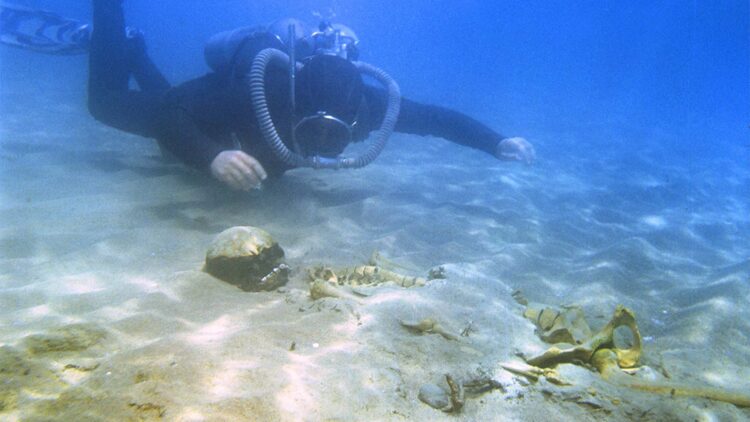
Archaeologists have confirmed the existence of a medieval city submerged beneath the waters of Lake Issyk-Kul in Kyrgyzstan. This discovery, made at Toru-Aygyr on the northwest shore of the lake, sheds new light on the historical significance of the Silk Road. The city is believed to have thrived until a devastating earthquake led to its demise, leaving behind remnants that can reshape our understanding of Central Asian history.
Surrounded by the towering peaks of the Tien Shan mountains, the underwater site has long been the subject of local legends. Researchers from various countries have now verified the existence of a planned urban center, encompassing evidence of its sophisticated structure and cultural diversity.
Unveiling the Underwater City
The archaeological team examined depths ranging from one to four meters and documented a wealth of artifacts. These include large ceramic vessels, baked brick remnants, parts of grain mills, and ornate architectural fragments. Such findings indicate the presence of public buildings, potentially serving as madrasas, mosques, or ritual baths.
The remnants suggest that the city was strategically positioned for traders, tourists, and pilgrims traveling between China and the Islamic world. Additionally, wooden structures and deteriorating stone walls hint at a well-planned urban design, likely supported by a stable local government. Researchers employed accelerator mass spectrometry (AMS) and dendrochronology to date wood and other materials accurately.
According to the findings, the city probably served as a major urban center during the Kara-Khanid dynasty, which dominated the region from the 10th to the 15th century. The archaeological evidence also reveals a mosaic of religious practices, with traces of Buddhism, Tengrianism, and Nestorian Christianity coexisting prior to the spread of Islam.
Catastrophe and Cultural Legacy
Archaeological findings indicate that a strong earthquake in the 15th century led to the city’s partial collapse, submerging most of it beneath Lake Issyk-Kul. Notably, the absence of human remains in certain residential areas suggests that parts of the city were abandoned prior to its final destruction. This preservation has frozen the city’s history in time, akin to the preservation seen in Pompeii.
Among the significant discoveries is a large Muslim cemetery dating back to the 13th and 14th centuries, encompassing approximately 60,000 square meters. This cemetery adheres to Islamic burial customs, with the deceased positioned facing north and southeast towards Mecca. To date, two skeletons—one male and one female—have been unearthed, which could provide valuable insights into their diet, health, and origins.
The influence of the Golden Horde in spreading Islam throughout Central Asia is also notable, as this shared faith facilitated trade and fostered trust among partners along the Silk Road. Other artifacts, including medieval ceramics and a large khum—a grain or water storage vessel—remain partially buried in sediment, indicating that further excavations could yield more discoveries.
As researchers continue to explore the site, they have uncovered additional structures and buried layers that suggest the region was inhabited over multiple cultural eras. The findings include round and rectangular adobe structures, highlighting the city’s long-term significance.
Future Research and Preservation Efforts
Advanced technologies, such as underwater drones and sophisticated navigation systems, have enabled archaeologists to map the submerged ruins in remarkable detail. The goal is to establish a comprehensive interdisciplinary project that integrates studies of funerary practices, urban archaeology, and the tectonic and climatic history of Lake Issyk-Kul.
Researchers believe that much of the city remains to be uncovered, with future explorations poised to further transform our understanding of Central Asia’s role in global history since the Middle Ages. The discovery not only enriches the historical narrative of the region but also highlights the cultural and economic exchanges that flourished along the Silk Road.