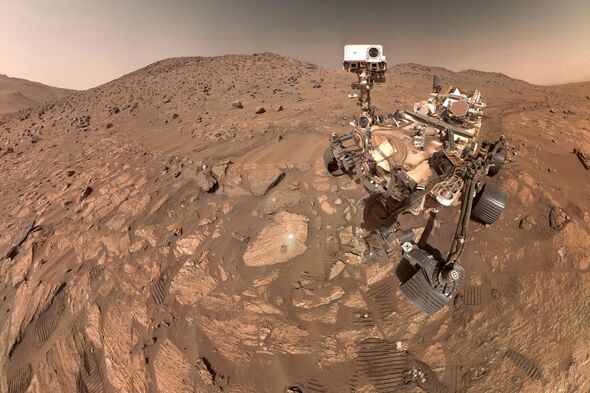
NASA’s Perseverance rover has made a groundbreaking discovery by capturing crackling sounds on Mars that scientists believe are indicative of lightning strikes. This remarkable finding represents the first documented evidence of what might be lightning on the Red Planet, a phenomenon previously suspected but not confirmed. The sounds were detected while the rover recorded wind noises, revealing a new aspect of Martian weather.
The research team, led by Baptiste Chide from the Institute for Research in Astrophysics and Planetology in Toulouse, identified these sounds over a period of two Martian years. They recorded a total of 55 instances of what they refer to as “mini lightning”, primarily during dust storms and dust devils. Most of these occurrences happened on the windiest days, known as sols, on Mars.
The crackling sounds were picked up by a specialized microphone mounted atop the rover’s tall mast. Notably, the electrical discharges occurred within just 6 feet (2 meters) of this instrument. The findings align with research that has confirmed the presence of lightning on other planets, including Jupiter and Saturn. The electrical activity detected on Mars produced sounds similar to static electricity experienced on Earth, creating a compelling new area for research into the planet’s atmospheric phenomena.
Chide expressed excitement about the implications of their findings, stating, “It opens a completely new field of investigation for Mars science. It’s like finding a missing piece of the puzzle.” This statement highlights the significance of the discovery, which could alter our understanding of Martian weather patterns.
Despite the strong evidence presented, some experts urge caution. Daniel Mitchard from Cardiff University, who was not involved in the study, noted that the findings are derived from a single instrument designed to record the rover’s laser activity on rocks, rather than specifically capturing lightning. He commented, “It really is a chance discovery to hear something else going on nearby, and everything points to this being Martian lightning.” However, he acknowledged that there may still be debates among scientists regarding the nature of the detected sounds.
The team analyzed approximately 28 hours of recordings to identify the perceived “mini lightning.” The discharges from dust devils were brief, lasting only a few seconds, while those from dust storms could be audible for up to 30 minutes. Chide described the experience as akin to a thunderstorm on Earth, albeit less visible and with more subtle discharges.
Chide further explained that Mars’ atmosphere might be more conducive to electrical discharges than that of Earth. Nevertheless, Mitchard reassured that the current evidence suggests it is highly unlikely that future astronauts on Mars will face the risk of being struck by lightning while performing tasks, such as planting a flag on the planet. “The small and frequent static-like discharges could prove problematic for sensitive equipment,” he cautioned in the journal Nature.
This discovery not only expands our understanding of Martian weather but also raises questions about the planet’s atmospheric dynamics. As scientists continue to analyze the data collected by the Perseverance rover, more insights into the electrical activities on Mars may emerge, enriching our knowledge of the Red Planet and its complex environment.