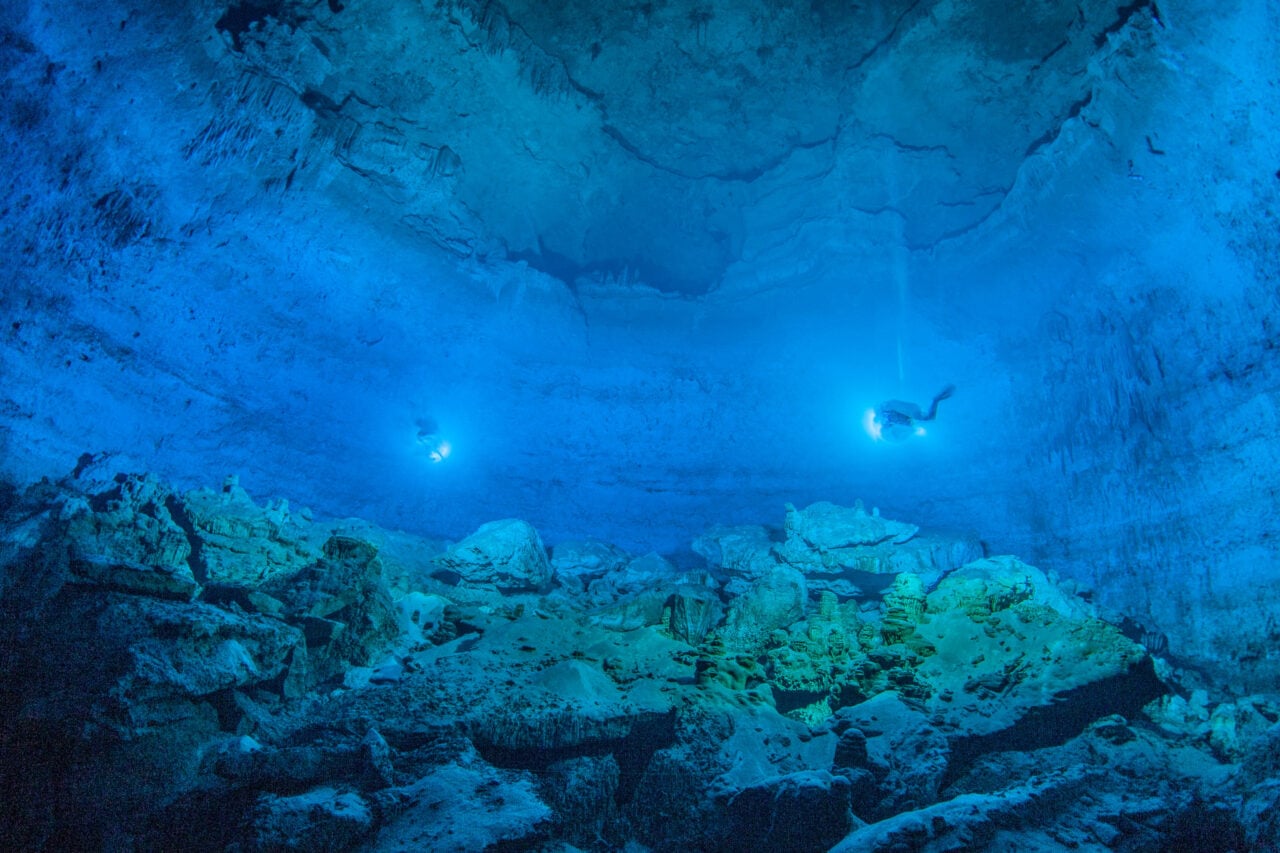
Deep beneath the tropical forests of the Yucatán Peninsula lies a vast subterranean world known as one of the most extensive underwater cave systems on Earth. Accessible through sinkholes called cenotes, these caves stretch potentially across thousands of kilometers. During the Late Pleistocene, from approximately 126,000 to 11,700 years ago, these tunnels were dry, hosting both humans and animals. Fossils and signs of human activity have remained undisturbed for millennia, revealing a rich history thanks to the efforts of specialized divers and international scientists.
A significant area of interest within this cave system, known as Hoyo Negro (or “Black Hole”), gained attention in 2014. Located in Sac Actun, the second-largest cave system in Quintana Roo, Hoyo Negro is a massive bell-shaped pit where numerous fossils, including that of Naia, one of the oldest human skeletons found in the Americas, were discovered.
The initial discovery of Hoyo Negro was made in 2007 by divers Alejandro Alvarez, Franco Attolini, and Alberto Nava Blank. In 2010, the National Institute of Anthropology and History (INAH) in Mexico established the Hoyo Negro Underwater Archaeological Project, which comprises a team of paleontologists, archaeologists, and divers from Mexico, Canada, and the United States.
Diving into the Depths
Since 2011, diver and co-director of the project Roberto Chávez Arce has been exploring the intricate tunnels of Sac Actun. His stunning photography has allowed scientists to glimpse this hidden world. However, the explorations are fraught with danger; when they began, the tunnels were largely unmapped and submerged in total darkness. Divers must carry essential safety gear, including breathing apparatus, lines to prevent getting lost, and lights. They also bring spare equipment, as Chávez Arce noted, “We need redundant gear in case [anything] fails.”
Accessing Hoyo Negro has improved significantly over time. Initially, divers entered the cave system through a cenote located over 914 meters from the pit, taking nearly an hour to swim there. Now, a newly discovered cenote is only 76 to 91 meters away, and divers utilize motorized scooters to speed through the water.
Mapping the cave system started with basic tools like compasses and tape measures. Eventually, the team transitioned to structure-from-motion (SfM) photogrammetry, a method that creates a 3D point cloud from overlapping photographs. This technological advancement has produced an impressive virtual model of Hoyo Negro, offering insights to scientists unable to dive into the depths themselves.
At its widest point, Hoyo Negro measures over 32 meters in diameter, expanding to over 67 meters at the base and plunging nearly 60 meters deep.
Uncovering the Past
Research into sediment cores and ancient bat guano has revealed that the water level in Hoyo Negro has fluctuated over time. The team found that water reached the bottom of the pit at least 9,850 years ago, and by 8,100 years ago, the upper passages were flooded. This timeline is vital for understanding when humans and animals accessed the cave and suggests that the Pleistocene ecosystem of Quintana Roo differed significantly from today’s lush jungles.
Fossils discovered in the cave provide clues about the dangers that existed. The same divers who uncovered Hoyo Negro also found Naia, a young girl who lived approximately 12,970 to 12,770 years ago. Naia is the most complete human skeleton among the three oldest known in the Americas. Evidence suggests she died following a fall into the pit, with a broken pelvis indicating a tragic accident.
“Naia landed right on her pubic bone,” explained Dr. James Chatters, a co-director of the project. “That’s what broke on both sides.” Analysis of Naia’s remains indicates she was around 4 feet 8 inches tall and likely died between the ages of 15 and 17.
The mystery of why Naia and other humans entered the cave persists. Possible explanations range from seeking clay, which provides essential minerals, to hunting hibernating animals or searching for water. The evidence of human activity is further demonstrated through ochre mining in nearby cave systems, highlighting the significance of this resource for decoration and burial practices.
Fossil footprints found within the tunnels suggest that animals, including bears, also ventured into these caves. The extinct short-faced bear, Arctotherium wingei, was among the many large mammals discovered. This species represents the first record of its tracks outside of South America.
In addition to bears, the cave has revealed fossils of various extinct carnivores, including Protocyon troglodytes, a wolf-like canid previously thought to be endemic to South America. The discovery of these fossils expands the understanding of ancient fauna and their biogeographic implications.
Research in Hoyo Negro also uncovered a new genus of ground sloth, Nohochichak xibalbahkah, which adds further depth to the understanding of prehistoric life. The combination of Mayan words in its name reflects its cultural significance, bridging ancient history with contemporary research.
Fossils of gomphotheres, extinct elephant-like creatures, have also been found in Hoyo Negro, suggesting these large animals sought water in the underground caves. The ongoing research led by experts like Joaquin Arroyo-Cabrales aims to unravel the reasons behind their presence in the region.
The findings in Hoyo Negro are part of a broader effort to understand North American fauna and their evolution, particularly in light of the Great American Biotic Interchange. As research continues, the team hopes to uncover more about the life that once thrived in these ancient caves.
As Blaine Schubert noted, “We still have a tremendous amount to learn about the paleobiology and evolution of America’s fauna, and caves will continue to be a primary resource for these discoveries.” Caves like Hoyo Negro offer a unique glimpse into the past, allowing researchers to explore the environments in which ancient organisms lived and died.