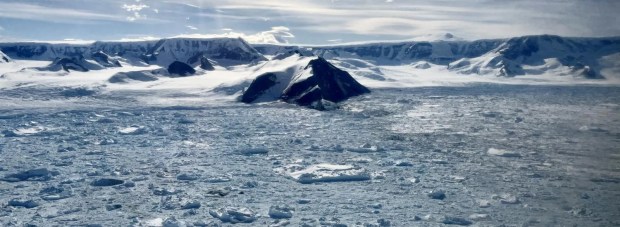
A team at the University of Colorado Boulder has revealed the remarkable speed at which the Hektoria Glacier in Antarctica has retreated. The glacier lost approximately half of its mass in just two months, a phenomenon that researchers describe as unprecedented for any grounded glacier recorded to date.
Between January 2022 and March 2023, the Hektoria Glacier retreated roughly 15.5 miles, marking a significant event in glaciology. Research Affiliate Naomi Ochwat spotted this rapid retreat while monitoring various glaciers in Antarctica. Her findings prompted further investigation into the mechanisms behind this alarming trend.
Understanding the Retreat Mechanism
Ochwat’s research highlights a particular process that allowed the glacier to retreat at such an extraordinary rate. She noted that if this process occurs on larger glaciers, it could have serious implications for the stability of the entire Antarctic ice sheet. “This could be problematic for sea level rise,” Ochwat emphasized, underlining the global consequences of such changes.
Although the Hektoria Glacier is relatively small by Antarctic standards—measuring about 8 miles across and 20 miles long—the retreat’s implications are significant. Senior Research Scientist Ted Scambos explained that the glacier’s retreat currently contributes only fractions of a millimeter to sea level rise. However, the process itself could indicate how other parts of Antarctica might behave under similar conditions.
The researchers identified that a layer of fast ice, which supports the glacier by connecting it to the coastline, began to break apart due to warmer conditions. This led to the disintegration of the glacier’s floating ice tongue, a critical component that helps stabilize the glacier. As the fast ice diminished, the glacier was left vulnerable, leading to more rapid melting.
New Insights into Ice Dynamics
The study revealed that the retreat of the Hektoria Glacier was mainly driven by a calving process occurring at the ice plain beneath it, rather than by atmospheric or oceanic conditions alone. The team utilized satellite-derived data, including images and elevation records, to analyze how the glacier behaved.
The phenomenon is reminiscent of a chain reaction, with large slabs of ice breaking off in succession. Scambos likened this process to “dominoes falling over backwards,” highlighting how interconnected the glacier’s structure is. Ochwat noted that the retreat mechanism they observed had not been documented before, making this research crucial for understanding similar glaciers.
The implications are critical: glaciers resting on ice plains may be prone to rapid destabilization. Previous research indicates that during warmer periods, such as 15,000 to 19,000 years ago, Antarctic glaciers with similar characteristics retreated at alarming rates, providing context for the findings regarding Hektoria.
Scambos stated, “It meant this grounded glacier lost ice faster than any glacier had in the past.” Recognizing this rapid retreat underscores the need to explore other areas in Antarctica where similar mechanisms might occur.
The potential impact of these findings extends beyond the scientific community. Ice sheets are significant reservoirs of freshwater, and their melting could lead to substantial sea level rise. According to the National Oceanic and Atmospheric Administration, nearly 30% of the U.S. population lives in coastal areas vulnerable to flooding, erosion, and storm hazards exacerbated by rising sea levels. Globally, eight of the ten largest cities are situated near coastlines, as reported by the United Nations Atlas of the Oceans.
Ochwat concluded, “What happens in Antarctica does not stay in Antarctica, and that’s why it’s really important to research these things because there’s so much we don’t know and so much that could have profound effects for us.” The urgency of these findings calls for continued research and monitoring of glaciers, as their stability may play a critical role in the future of global sea levels.