URGENT UPDATE: As artificial intelligence rapidly evolves, top CEOs are integrating AI into their daily routines, revolutionizing how they work and live. From streamlining communication to enhancing personal productivity, these leaders are leveraging AI tools NOW, with significant implications for their industries.
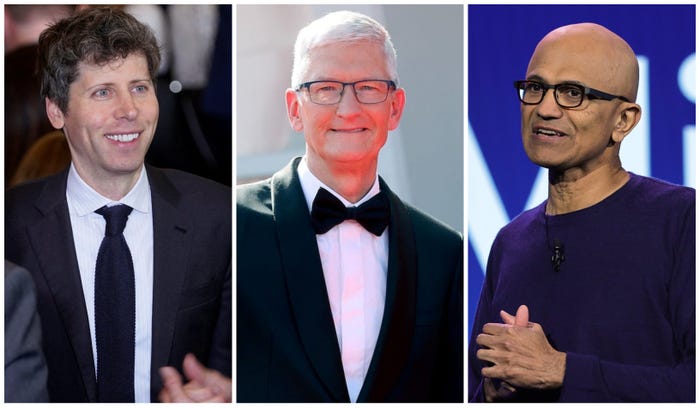
In a recent report, industry giants like Satya Nadella of Microsoft and Tim Cook of Apple reveal how AI has become indispensable to their operations. The global AI market is projected to soar to $4.8 trillion by 2033, with potential contributions of $15.7 trillion to the economy by 2030, according to consulting firm PwC.
Microsoft’s Nadella uses AI daily to manage his workflow, employing the Copilot app to summarize emails and prepare for meetings. “I’m an email typist,” Nadella shared, emphasizing how AI is essential for efficiency, even during his commute. His team has integrated at least 10 custom agents from Copilot Studio to optimize productivity.
Meanwhile, Sam Altman, CEO of OpenAI, has also embraced AI in personal tasks. After welcoming his first child, he remarked, “I use it constantly,” illustrating how AI assists him with parenting duties and document management. Altman’s insights into AI’s potential for everyday tasks resonate widely, as the technology continues to permeate various sectors.
At Nvidia, CEO Jensen Huang views AI as an educational tool. “I use it as a tutor every day,” he stated, showcasing the technology’s ability to simplify complex concepts and bridge knowledge gaps. Huang’s advocacy for AI’s accessibility reflects a broader industry trend toward democratizing technology.
Apple’s Tim Cook is also leveraging AI to enhance his productivity. He revealed that Apple Intelligence helps him summarize lengthy emails, saying, “It’s changed my life.” This sentiment is echoed across the tech landscape, highlighting AI’s transformative impact on day-to-day operations.
In real estate, Jeremy Wacksman of Zillow is leveraging AI for efficiency in meetings and documentation. “That’s far more valuable to me than to try to read a transcript at one-and-a-half speed,” he explained, emphasizing the personalized summaries AI can generate for executives.
Coinbase’s Brian Armstrong has taken AI integration to the next level, claiming the first “AI to AI crypto transaction.” He stated on X that his team is testing AI’s decision-making capabilities, even firing employees who resisted adopting AI tools into their workflows, highlighting the urgency of staying competitive in the tech space.
At LinkedIn, Ryan Roslansky utilizes AI for drafting critical communications. “You’ve got to make sure you sound super smart,” he confessed, illustrating how even the most seasoned executives rely on AI to ensure clear and impactful messaging.
In the healthcare sector, David Ricks of Eli Lilly is creating an AI-powered platform for drug discovery, partnering with Nvidia to develop the most powerful supercomputer in the pharmaceutical industry. “I have at least one or two AIs running every minute of every meeting I’m in,” Ricks said, accentuating AI’s role in enhancing scientific discussions.
As we witness this wave of AI adoption among top executives, the implications for both personal and professional landscapes are profound. These leaders are setting the pace for AI integration, making it clear that the future is NOW.
What’s Next: As AI technology continues to evolve, expect ongoing updates from these leaders about their experiences and innovations. Stay tuned for more developments as companies race to harness the power of AI in transforming their operations and enhancing productivity.