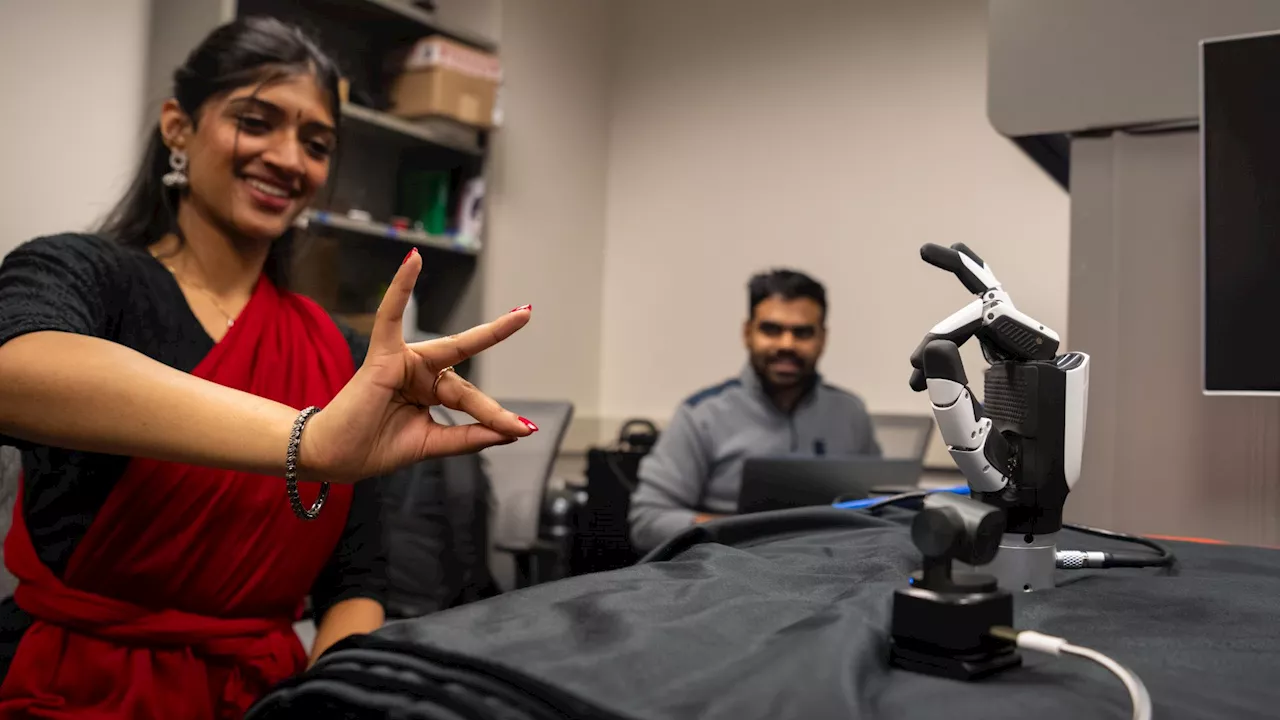
A recent study from the University of Maryland, Baltimore County (UMBC) highlights the potential of traditional Indian classical dance to enhance robotic hand movement learning. Researchers explored Bharatanatyam hand gestures, known as mudras, and found they may provide insights into advanced robotic motion capabilities.
The study reveals that classical dance encodes more intricate motion patterns compared to everyday hand actions. This discovery could significantly influence both the development of robotic systems and therapeutic approaches to fine motor skills rehabilitation.
Decoding Movement Patterns
The research, led by Ramana Vinjamuri, a professor at UMBC, focuses on the concept of kinematic synergies. These synergies represent coordinated joint movements that the brain uses to simplify complex physical actions. Vinjamuri likens these synergies to an alphabet, where different combinations can create a diverse array of hand gestures.
Initially, the research team examined 30 natural hand grasps, such as holding a small bead or lifting a large bottle. They identified six key synergies that encompassed almost all variations of these movements. Subsequently, they conducted a similar analysis on 30 Bharatanatyam mudras, discovering six synergies that exhibited greater flexibility and dexterity.
To assess the effectiveness of these findings, the researchers attempted to reconstruct 15 letters of the American Sign Language (ASL) alphabet using both synergy sets. The results showed that the mudra-based system outperformed the natural grasp system, achieving higher accuracy in gesture production.
Vinjamuri’s interest in the study was sparked by observing aging dancers. He noted, “We noticed dancers tend to age super gracefully: They remain flexible and agile because they have been training.” This observation prompted the team to investigate whether the refined movements of trained dancers could provide a more advanced set of motion building blocks.
Implications for Robotics and Rehabilitation
The implications of this research extend beyond dance. The team is applying these findings to the field of robotics. Instead of programming robots to mimic specific gestures, they are developing systems that allow machines to combine fundamental movement alphabets to generate new hand shapes.
The researchers are currently testing this innovative approach on both a robotic hand and a humanoid robot, utilizing different translation methods ranging from mathematical modeling to actual movement applications. Additionally, they have created a low-cost system that employs cameras and software to record and analyze hand gestures. Vinjamuri envisions this approach could lead to accessible physical therapy tools that assist patients with rehabilitation exercises in the comfort of their homes.
Curiosity remains a driving force behind their work. Parthan Olikkal, a Ph.D. researcher in the lab, expressed his enthusiasm, stating, “Once I learned about synergies, I became so curious to see if we could use them to make a robotic hand respond and perform the same way as a human hand.” He described the process of integrating his own work into the broader research efforts as deeply rewarding.
This study, published in the journal Scientific Reports, underscores the potential intersections of art and technology, paving the way for advancements in both robotic applications and therapeutic practices.