Researchers at the Vienna University of Technology have developed a new method to produce the copper isotope Cu-64, which could significantly reduce the costs associated with medical imaging. This innovative approach employs a technique known as “recoil chemistry” to generate Cu-64 from Cu-63 using neutron irradiation, a process that promises to simplify production and enhance accessibility for medical applications.
Cu-64 is crucial in medical imaging and cancer therapy due to its radioactive properties. Unlike Cu-63, which is stable and found naturally, Cu-64 must be artificially produced, traditionally through a complex process involving the bombardment of nickel atoms with protons. This conventional method is not only expensive but also requires specialized equipment such as cyclotrons and enriched nickel isotopes.
Revolutionizing Copper Isotope Production
The existing method for producing Cu-64 entails bombarding Ni-64 with protons, resulting in the transformation of nickel nuclei into copper. As Veronika Rosecker, a researcher at TU Wien, explains, “The nickel nucleus absorbs a proton, ejects a neutron, and is thereby transformed into copper-64.” While effective, this technique is resource-intensive and limited by the availability of enriched nickel.
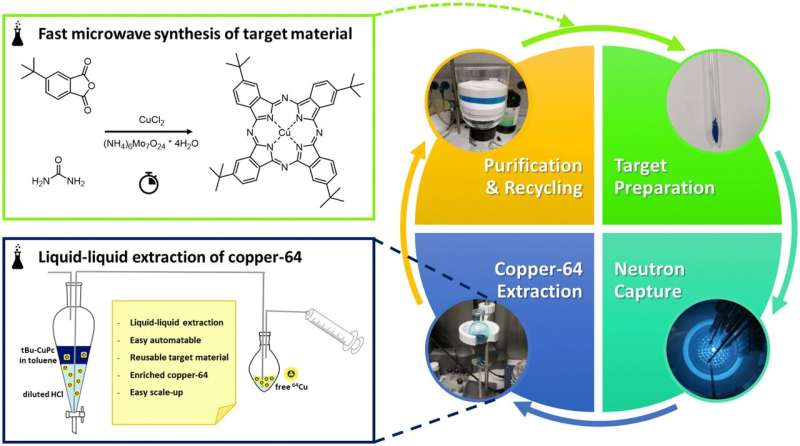
In contrast, the new method aims to convert Cu-63 into Cu-64 by simply adding a neutron. Although this approach presents challenges, particularly in separating the newly formed Cu-64 from the ordinary copper atoms, the researchers have successfully utilized recoil chemistry to address this issue.
When Cu-63 is irradiated with neutrons, Cu-64 nuclei are produced, but the mixture predominantly contains regular copper. According to Martin Pressler, “It is almost impossible to separate them chemically from the ordinary copper atoms.” The breakthrough comes from leveraging the recoil produced when Cu-63 absorbs a neutron and transforms into Cu-64. This recoil, akin to a rocket’s thrust, ejects the Cu-64 atom from its molecular structure, allowing for effective separation.
Efficient and Sustainable Production
A critical component of this research involved identifying an appropriate molecule that would remain stable under reactor conditions yet be soluble enough for efficient processing. The team succeeded by creating a metal-organic complex that mimics heme, the molecule found in human blood. Previous studies on similar substances faced challenges with solubility, but the new complex has been chemically modified to enhance its properties.
This method not only simplifies the production of Cu-64 but also allows for automation and reuse of the molecules without degradation. As a result, it eliminates the need for cyclotron access, utilizing instead a standard research reactor, such as the one at TU Wien.
The findings of this study, published in the journal Dalton Transactions, represent a significant advancement in the field of medical imaging. The ability to produce Cu-64 more efficiently could lead to lower costs for medical facilities and improved access for patients requiring imaging and therapeutic procedures.
In summary, the innovative approach developed by researchers at the Vienna University of Technology stands to transform the production of Cu-64, making it more accessible and affordable for medical applications. This could ultimately enhance patient care and broaden the use of this essential isotope in the medical field.