
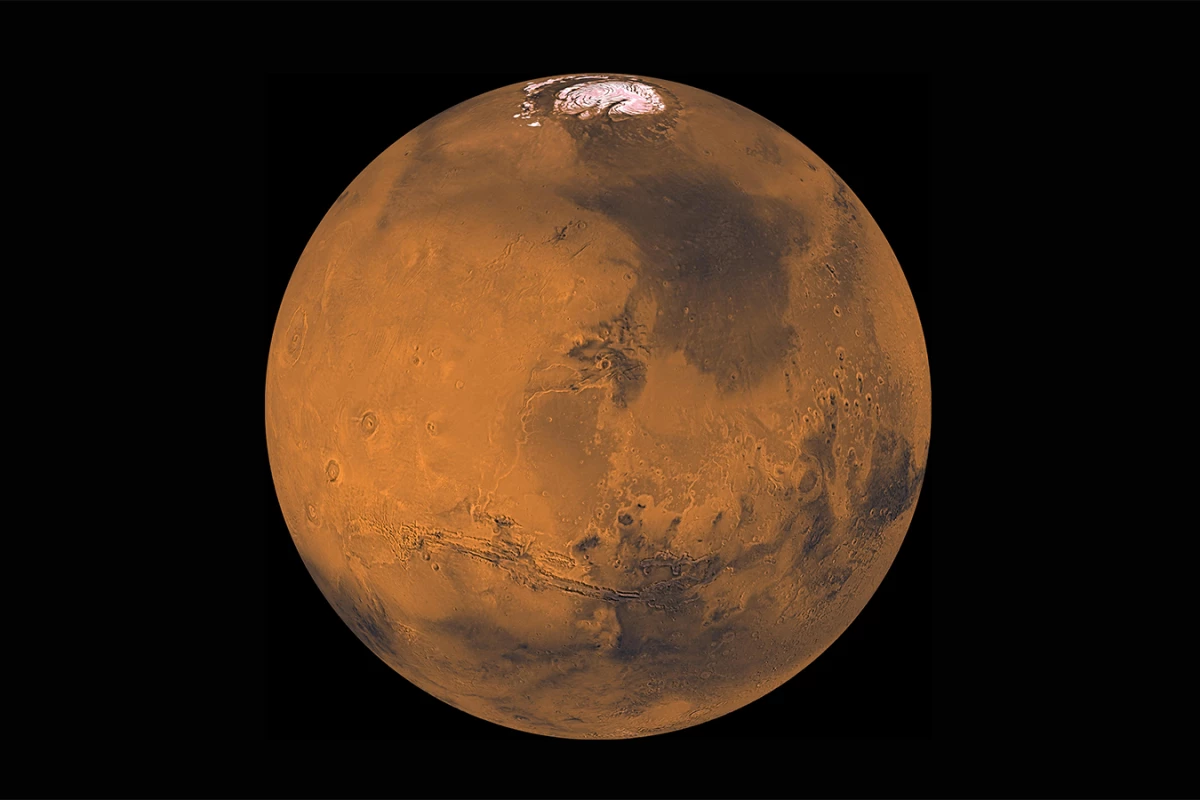
A recent study from the National Institute of Standards and Technology (NIST) reveals that time on Mars runs significantly faster than on Earth, presenting complications for future human missions to the Red Planet. Researchers, including physicists Neil Ashby and Bijunath Patla, calculated that time on Mars accelerates by approximately 477 microseconds per day compared to Earth, a finding that has implications for navigation and communication systems.
Understanding this phenomenon requires a grasp of Albert Einstein‘s Theory of Relativity, which transformed our comprehension of space and time. Time dilation, a key concept in this theory, explains that time is not a constant; it varies based on speed and gravitational influence. For instance, the differences in time experienced by astronauts traveling at high speeds or near massive celestial bodies can be significant.
One notable example of time dilation in practice is with GPS satellites. These satellites orbit Earth at speeds of about 28,000 km/h (17,500 mph), causing them to experience time differently than clocks on the ground. As Ashby pointed out, GPS technology must account for these differences; otherwise, positional calculations could be inaccurate by several miles daily.
Complexities of Mars Timekeeping
The complications for Mars are amplified due to its elliptical orbit around the Sun, which causes variances in its speed throughout the Martian year. This creates what is known as a “four-body problem,” where the gravitational influences of Mars, Earth, the Moon, and the Sun must all be considered. In contrast, calculations for the Moon are relatively straightforward, involving only the Earth and Moon’s gravitational effects.
The NIST researchers found that the time discrepancies on Mars could fluctuate by about 266 microseconds, necessitating precise adjustments to any potential timekeeping systems used during missions. This adds layers of complexity to the logistics of communication with Earth, as an inaccurate timekeeping system could lead to significant errors in data transmission.
Future Missions to Mars and Time Issues
As plans for frequent human missions to Mars develop, understanding Martian time becomes even more critical. The research not only sheds light on the practical challenges of future space expeditions but also enhances our overall understanding of relativity and how it applies to different environments.
“It’s good to know for the first time what is happening on Mars timewise,” Ashby stated. He emphasized that this knowledge improves our understanding of how time is influenced by various factors, which is crucial for the ongoing exploration of our solar system.
The findings were published in The Astronomical Journal, marking a significant step forward in the study of time in extraterrestrial environments. As humanity continues its journey into space, addressing the challenges posed by time dilation will be essential for successful navigation and communication on Mars and beyond.


