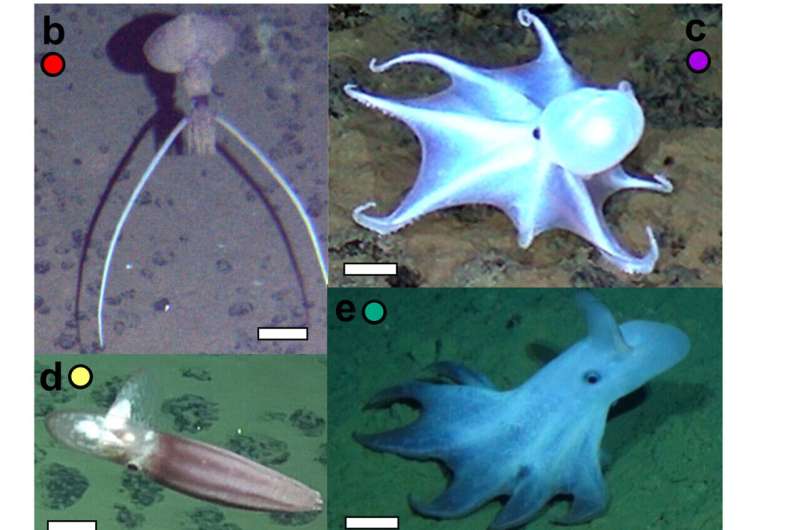
Researchers recently documented a remarkable behavior exhibited by a deep-sea squid in the Pacific Ocean, challenging previous assumptions about cephalopod populations in the abyssal plains. In March 2023, while conducting visual surveys in the Clarion-Clipperton Zone (CCZ) at a depth of approximately 4,100 meters, scientists observed a squid utilizing a unique disguise technique to evade detection. This discovery, detailed in a study published in the journal Ecology, sheds light on the complexities of life in one of the ocean’s least understood environments.
A Surprising Discovery
The research team employed a remotely operated vehicle (ROV) equipped with multiple cameras to explore the deep-sea ecosystem. Initially, the angled camera captured what appeared to be biogenic stalks, typically associated with organisms like glass sponges or large tube worms. Just seconds later, a squid swiftly swam across the camera’s view. The team was surprised, as earlier footage showed no sign of the squid.
Upon further analysis, the researchers realized the squid had been hiding beneath the sediment, nestled among polymetallic nodules. “The squid only became obvious after it abandoned this behavior and swam away, disturbed by the proximity of the ROV,” the study authors noted. This behavior, characterized by the squid lying motionless in an upside-down position with its siphon and elongated tentacles extended, is now recognized as a form of masquerading.
Masquerading Behavior and Its Implications
Masquerading, which allows the squid to blend into its environment, could serve multiple purposes. It may help the creature avoid predators like beaked whales or remain undetected by potential prey. The squid measured approximately 10 centimeters in mantle length, with tentacles extending up to 22 centimeters. The researchers believe this specimen may be a previously undescribed species of whiplash squid from the Mastigoteuthidae family.
This observation marks the first documented instance of masquerading behavior in deep-sea cephalopods. Historically, whiplash squids have been encountered only once in the Northeast Pacific abyss, with just four cephalopod sightings recorded since seabed surveying began in the 1970s. The team suggests that their rarity may be less about low numbers and more about their adeptness at concealing themselves.
The authors emphasize that current estimates of cephalopod populations in these regions likely underestimate their true abundance. The ability of these creatures to disguise themselves and avoid detection complicates efforts to assess their ecological roles and distributions.
Understanding the ecosystems of the abyssal seabed is increasingly crucial, as these areas face threats from climate change and seabed mining activities. The team warns that without adequate research, the future of these deep-sea habitats remains uncertain. They advocate for more targeted studies utilizing unobtrusive camera platforms to enhance knowledge of deep-sea cephalopod diversity and behaviors before these environments undergo irreversible changes.
This research highlights the vast unknowns that still exist within the abyssal plains, which cover more than half of the Earth’s surface. As scientists uncover the secrets of these deep-sea ecosystems, they may also inform better conservation and management strategies to protect these delicate habitats.
This article is based on research conducted by Alejandra Mejía-Saenz et al., as published in Ecology. The study underscores the necessity of continued exploration and understanding of the ocean’s depths, particularly in the face of increasing anthropogenic pressures.