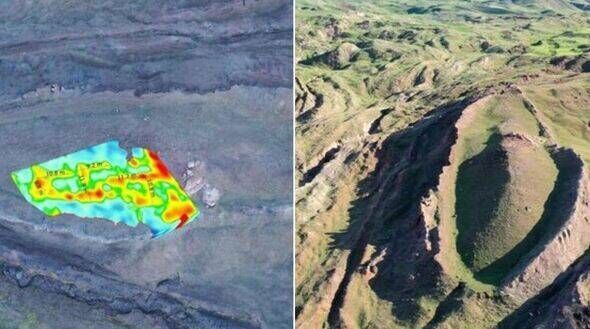
Archaeologists have made a significant discovery in Turkey, utilizing advanced radar technology to identify what they believe are remnants of Noah’s Ark. The research team, led by independent researcher Andrew Jones from Noah’s Ark Scans, employed Ground Penetrating Radar (GPR) analysis at the Durupinar Formation, situated approximately 18 miles south of Mount Ararat. Their findings suggest the presence of a “chemical imprint,” pieces of wood, and a distinct hall-like shape beneath the surface.
The biblical narrative describes Noah’s Ark as a vessel that saved humanity and various animal species from a catastrophic flood over 4,300 years ago. The scans revealed angular formations and a hollow space deep within the mountain, which researchers speculate could correspond to the ark’s dimensions. According to the Bible, specifically in Genesis 6:16, the ark was designed with three decks: “Make it with lower, second, and third decks.”
In an interview with CBN News, Jones expressed realistic expectations about the state of the findings. He stated, “We’re not expecting something that’s fully preserved. What’s left is the chemical imprint, pieces of wood in the ground, the shape of a hall.” The Durupinar Formation, known to modern researchers for less than a century, first came into the public eye after heavy rains and seismic activity in May 1948 uncovered its secrets.
The formation’s location near a peak resembling the biblical dimensions of the ark has fueled debate among scholars. Some argue that the structure is merely a natural rock formation, while others, including Jones and his team, maintain that it indicates a man-made vessel. In a separate interview, Jones detailed their recent scans, which identified a corridor approximately 13 feet wide running through the formation.
The scans also indicated multiple layers beneath the surface, aligning with the description of the ark’s three decks. The findings have raised eyebrows among researchers, as they challenge traditional geological interpretations of the site.
Jones highlighted that the grass growing within the formation appears to be a different color compared to surrounding areas, suggesting a possible artificial origin. Fellow researcher William Crabtree noted a passageway extending from the formation’s tip to its center, spacious enough for a person to walk through. Crabtree’s soil tests revealed that organic matter within the formation was double that of the surrounding earth, with potassium concentrations approximately 40 percent higher.
Crabtree explained, “If this was a wooden boat and the wood had rotted over time, we would expect to see elevated levels of potassium, changes in pH, and higher organic content—and that’s exactly what we’re finding.” The researchers plan to expand their soil testing beyond the 22 specimens already gathered. They will also conduct core drilling and further GPR surveys to deepen their understanding of the site.
As this research progresses, it may provide a clearer picture of whether these findings substantiate the existence of a man-made structure. The implications of such a discovery could reverberate beyond archaeological circles, potentially impacting theological discussions and historical narratives surrounding one of the most famous stories in the Bible.