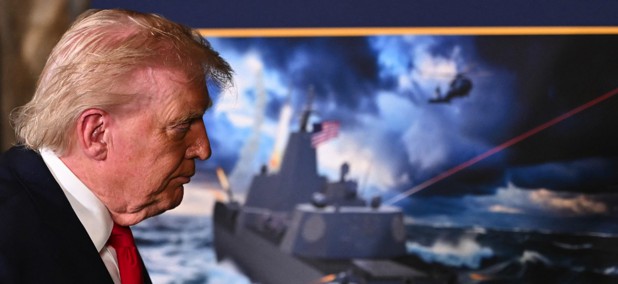
President Donald Trump has proposed a new class of warships bearing his name, but the plan has sparked controversy due to its intention to arm these vessels with a new nuclear-armed cruise missile. This approach appears to contradict Trump’s earlier stance, expressed in February 2021, when he stated, “There’s no reason for us to be building brand-new nuclear weapons. We already have so many.”
The proposal raises significant concerns regarding the implications of reintroducing tactical nuclear weapons, specifically sea-launched cruise missiles (SLCM-N). Historically, this issue has been contentious. In 1991, then-President George H.W. Bush ordered the removal of all nuclear-armed Tomahawk cruise missiles from Navy surface ships and submarines. Bush deemed their forward deployment to be destabilizing and opted to place them in storage.
Two decades later, under President Barack Obama, there was a push from U.S. Navy leaders to remove these weapons from storage and dismantle them permanently. This decision limited the Navy’s nuclear mission to strategic missiles on select submarines, a strategy widely regarded as stabilizing.
In a surprising turn, the Nuclear Posture Review signed by James Mattis, Trump’s defense secretary, and General Mark Milley, chairman of the Joint Chiefs of Staff, in 2018 approved the development of a new SLCM-N. Although President Biden cancelled this program in 2021, Congress overruled this decision and continued to fund it. This rare move highlights an unusual instance of the legislative branch compelling the executive to initiate a new nuclear weapons program.
Andrew C. Weber, a Senior Fellow at the Council on Strategic Risks and former Assistant Secretary of Defense for Nuclear, Chemical, and Biological Defense Programs, supports modernization of the strategic nuclear triad. However, he opposes the development of the SLCM-N for three primary reasons.
First, he argues that introducing a tactical nuclear weapon may lead adversaries to miscalculate their responses in a conflict. If an adversary perceives that the U.S. would respond with a similarly small tactical nuclear weapon, it could embolden them to use such weapons first, rather than fearing a massive retaliation. Weber emphasizes the importance of maintaining a strong strategic deterrent that leverages conventional advantages.
Second, the presence of tactical nuclear weapons heightens the risk of their use in regional conflicts, potentially leading to what is termed a limited nuclear war. Once the threshold for nuclear engagement is crossed, the likelihood of escalation to an all-out nuclear exchange increases dramatically.
Lastly, Weber expresses concern over the potential for miscalculation or accidental nuclear conflict. He notes that tactical nuclear weapons exist alongside conventional variants, creating confusion during engagements. In a situation where intelligence capabilities are compromised, an adversary may mistakenly interpret a conventional attack as nuclear, prompting a nuclear response.
As the debate unfolds, Weber advocates for the United States to focus on strengthening its existing strategic weapons triad, rather than pursuing the development of new tactical nuclear options. In pursuing a new battleship program, President Trump has an opportunity to reaffirm his previous statements by investing in more strategic capabilities, rather than diverting resources to a tactical nuclear weapon that could undermine national security.