
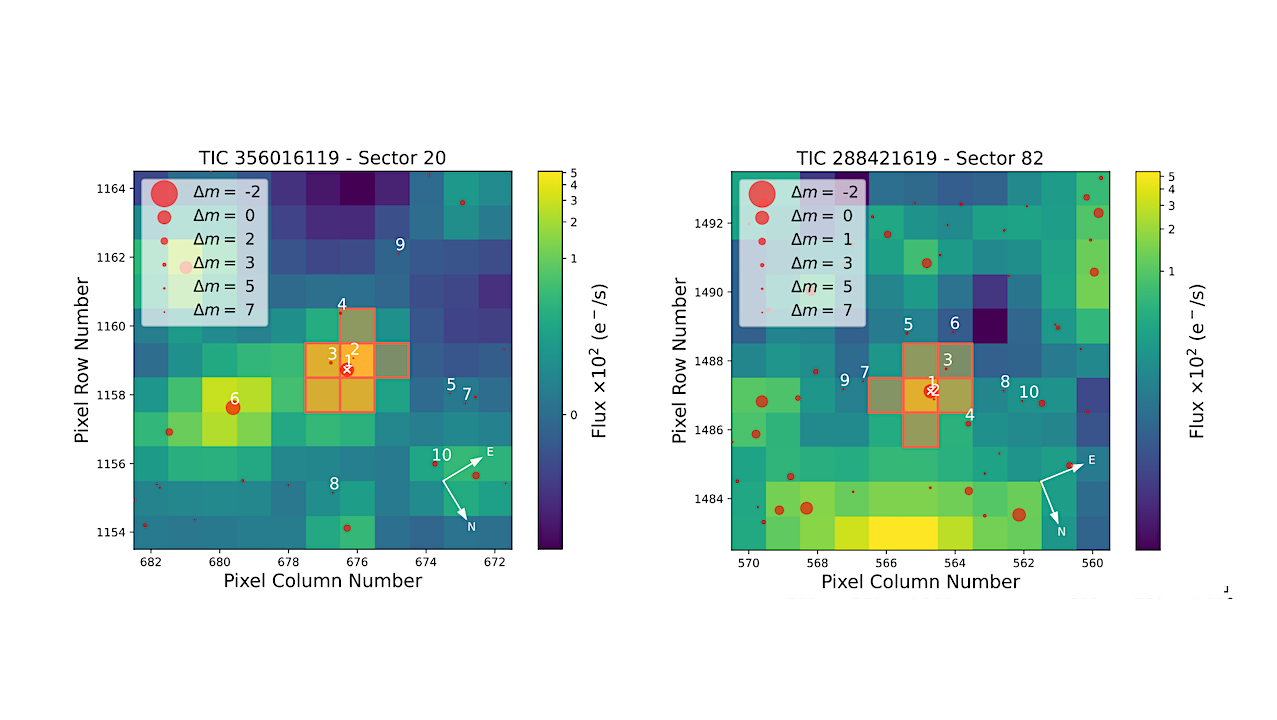
Recent findings in exoplanet research have confirmed the existence of two new temperate mini-Neptunes located within the habitable zones of their host stars. These planets, identified as TOI-2094 b and TOI-7166 b, represent significant candidates for further atmospheric characterization. The validation process utilized multicolour photometric transit observations, which enhance the ability to prioritize targets for subsequent follow-up studies.
The research, conducted by a team led by Chengzi Jiang, involved a detailed analysis of light curves obtained from the Transiting Exoplanet Survey Satellite (TESS) and ground-based observations, including HiPERCAM at the Gran Telescopio Canarias (GTC). By applying Bayesian model comparison techniques, the team was able to accurately determine the transit and physical parameters of these planets.
Key Findings on Mini-Neptunes
TOI-2094 b, with a radius of 1.90 Earth radii, orbits an M3V star every approximately 18.79 days, placing it well within the habitable zone, with about 0.98 Earth insolation. In contrast, TOI-7166 b has a radius of 2.39 Earth radii and orbits its M4.5V host star every 12.92 days, situating it near the inner edge of the habitable zone, receiving approximately 1.93 Earth insolation.
Statistical estimates of mass and density suggest that TOI-2094 b is likely to be a volatile-rich planet, potentially resembling a water world or a gaseous planet, as opposed to being rocky. Meanwhile, TOI-7166 b is also considered to be volatile-rich. The implications of these findings are significant, as both planets are prime candidates for detailed atmospheric studies using the James Webb Space Telescope (JWST) and future Extremely Large Telescopes (ELTs).
Implications for Future Research
The validation of these two mini-Neptunes not only expands the catalog of known habitable-zone exoplanets but also underscores the effectiveness of multicolour validation techniques. This method allows researchers to filter potential candidates before engaging in more resource-intensive radial-velocity follow-up studies.
The research highlighted the importance of gathering precise measurements concerning the masses of TOI-2094 b and TOI-7166 b. Accurate mass data will be crucial for understanding their compositions and for future atmospheric characterization efforts. With both planets situated in zones conducive to life, they represent exciting opportunities for the ongoing exploration of exoplanets beyond our solar system.
These findings have been documented in a comprehensive study and are available for further review. The team aims to continue their work in this field, contributing to the ever-growing knowledge of potentially habitable worlds beyond Earth.


