In New Mexico’s high desert, the Los Alamos National Laboratory (LANL) continues its legacy of pioneering nuclear research, originating from its role in the Manhattan Project. The lab is currently making significant strides in neutrino physics and advanced weaponry, drawing attention to a critical report from 1993 that remains relevant in contemporary discussions. The document, titled “Recent Developments in Neutrino Physics” and cataloged as LA-UR-93-1350-25, showcases early 1990s advancements in neutrino studies that are essential for understanding the universe.
Authored by researchers working under the U.S. Department of Energy and the University of California, the report details experimental findings on neutrino oscillations. At that time, scientists were investigating anomalies in solar neutrino detection, proposing that these particles might change “flavors” as they traveled from the sun. This concept posed challenges to established theories, laying the groundwork for discoveries that would later earn Nobel Prizes.
Current Innovations and Research Directions
Today, LANL’s neutrino research reflects a broader resurgence in nuclear science. The Los Alamos Neutron Science Center is now utilizing high-intensity proton accelerators to explore neutron interactions, a venture that informs both fundamental science and national security. Recent work directly builds upon the insights from the 1993 report, adapting them for modern computational models and international collaboration.
Experts highlight that neutrino physics has increasingly intersected with fields like cosmology and quantum mechanics. For instance, a recent paper from the lab’s theoretical division examined neutrino-nucleus scattering, crucial for identifying dark matter candidates. This focus aligns with a broader trend in multi-messenger astronomy, where neutrinos are analyzed alongside gravitational waves and cosmic rays, enhancing understanding of high-energy astrophysical phenomena.
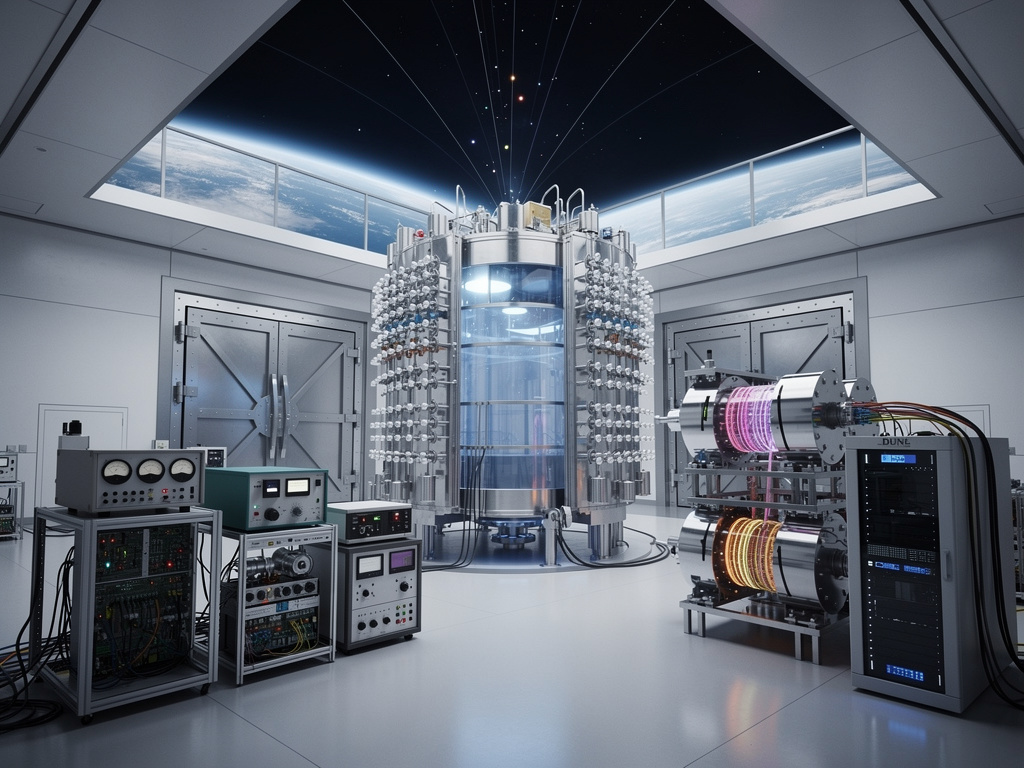
LANL’s involvement in the Deep Underground Neutrino Experiment (DUNE) further illustrates the evolution of neutrino research. This collaborative project aims to send neutrino beams from the Fermi National Accelerator Laboratory in Illinois to South Dakota, measuring oscillations over significant distances to clarify neutrino properties. Notably, simulations informed by historical data from the 1993 report have been vital in designing DUNE’s detectors.
National Security and Ethical Considerations
While the lab’s scientific contributions are significant, its nuclear pursuits are deeply intertwined with national defense. LANL’s history includes the development of the hydrogen bomb and ongoing plutonium pit production, essential for modernizing the U.S. nuclear arsenal. Reports indicate that the lab is increasing output to meet Pentagon requirements, raising ethical questions about the militarization of scientific research.
The connection between neutrino research and nuclear weapons design is complex. Experts reveal that models of neutrino interactions assist in predicting fission processes in warheads, ensuring reliability without live testing, which is prohibited by international treaties. Recent incidents, such as a contamination event in November 2025 during glovebox maintenance, underscore the operational challenges the lab faces. Three workers were exposed to low levels of radioactive material, prompting reviews by the Defense Nuclear Facilities Safety Board.
Aging infrastructure at LANL poses additional challenges. Facilities built decades ago struggle to meet contemporary demands, while contamination risks and work disruptions persist. Despite these hurdles, investments in new supercomputers are being made to simulate nuclear reactions on scales previously unattainable, as highlighted in a December 2025 address by lab officials.
Innovations in Detection and Global Collaborations
LANL is at the forefront of nuclear forensics, with recent developments in technology aimed at detecting illicit nuclear materials. A mass spectrometer currently being tested can identify contraband in under 30 minutes, enhancing global security efforts. This technology echoes particle detection techniques outlined in the 1993 report, now refined through AI-driven analysis.
Collaborations with institutions like the Idaho National Laboratory are fostering advancements in modular nuclear systems. The lab is exploring partnerships with private firms to develop small modular reactors, which promise efficiency improvements in energy production. Discussions on social media platforms reflect excitement about these developments, although critics caution that such advancements could exacerbate arms races.
A Legacy of Scientific Inquiry and Future Directions
The relationship between fundamental research and applied technology at LANL remains a defining characteristic. Insights from the 1993 neutrino report have influenced ongoing projects in fusion energy, including contributions to NASA’s lattice confinement fusion experiments. These initiatives aim to provide clean energy alternatives, diverging from weaponry while leveraging similar scientific principles.
As global tensions rise, LANL’s dual mission of scientific discovery and national defense faces increased scrutiny. Funding for AI integration and predictive modeling is essential for maintaining a competitive edge in a rapidly changing technological landscape. The lab’s promise lies in its ability to bridge past discoveries with future innovations, ensuring that foundational research continues to inform critical applications.
Looking toward the future, LANL is well-positioned to address significant challenges, from applying quantum computing in particle simulations to improving climate modeling influenced by nuclear processes. The lab’s ongoing commitment to refining radiation safety protocols is crucial, especially in light of recent incidents. As it navigates the complexities of its legacy, LANL remains a vital player in both scientific and national security arenas, reflecting the intricate balance between research and responsibility in a rapidly evolving world.