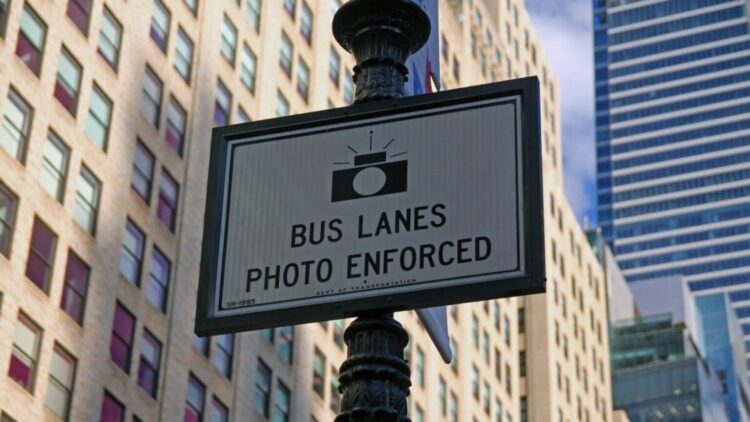
The Metropolitan Transportation Authority (MTA) has officially launched an expansion of its Automated Camera Enforcement (ACE) program in New York City, targeting private vehicles that unlawfully occupy bus lanes. This initiative aims to enhance urban mobility by improving the efficiency and safety of public transportation across the boroughs of Queens and the Bronx.
The ACE program, which utilizes camera systems mounted on buses, will now cover additional routes, including the Q6, Bx20, Bx3, and Bx7 lines. These measures are designed to reduce traffic congestion and ensure that buses can operate smoothly, without obstruction from private vehicles. Offenders caught blocking bus lanes will face fines ranging from $50 for first-time offenses to as much as $250 for repeat violations.
Enhancing Public Transport Safety
Public transportation systems in major cities like New York play a crucial role in promoting economic and social efficiency. Buses, in particular, serve as a vital mode of transport for many residents, providing safety and accessibility. Yet, the illegal behavior of some drivers in invading designated bus lanes poses significant challenges to the system’s functionality and jeopardizes passenger safety.
Dedicated bus lanes were introduced to separate bus traffic from regular road congestion, speeding up travel times for public transport. Despite this, many private vehicle drivers often disregard these regulations, further complicating the already congested roadways. This prompted the MTA to take action through the ACE program, which aims to penalize such infractions effectively.
According to an official statement from the MTA, “The ACE program is a bus-mounted camera system that issues violations to vehicles occupying bus lanes, to double-parked vehicles along bus routes, and to vehicles blocking bus stops. When bus stops are blocked, buses can’t reach the curb, and people in wheelchairs are often unable to board. In these scenarios, buses are forced to pick up and drop off passengers in the street, creating a safety hazard for all passengers.”
Expansion and Future Goals
Currently, the ACE program operates on 51 routes and serves over 840,000 passengers each week. The recent expansion aims to build on this success by incorporating four new lines that are strategically important for the communities in Queens and the Bronx. This decision reflects a broader strategy to discourage illegal lane usage by private drivers and promote compliance with traffic regulations.
The MTA has also toughened penalties for violators. Initially, offenders detected by the ACE system will receive a $50 fine as a warning. Should they commit further violations, fines will increase, possibly reaching $250. The MTA anticipates that these measures, combined with the expanded coverage of the ACE program, will discourage drivers from encroaching on bus-only lanes.
As New York City continues to evolve, the integration of technology in traffic enforcement signifies a commitment to improving urban transport systems. The ACE program is a clear step toward ensuring that public transport remains a reliable and safe option for all residents.