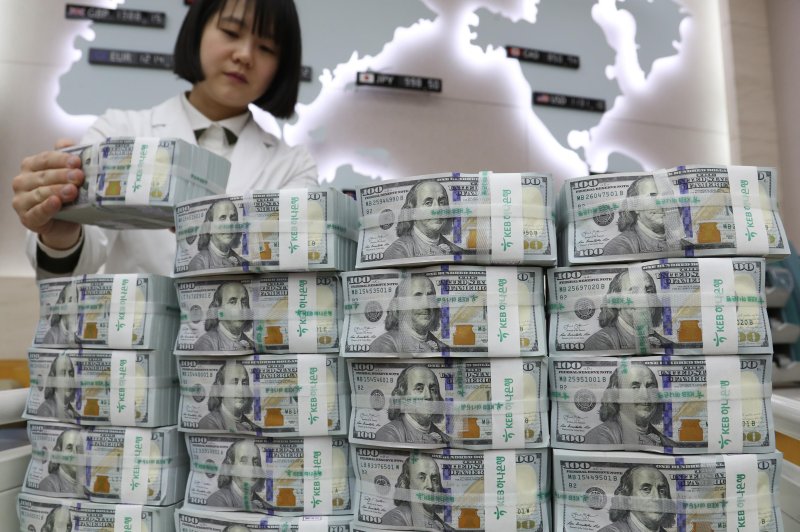
Korea’s foreign exchange reserves experienced a notable decline at the end of December 2022, marking the first drop in seven months. This decrease reflects concerted efforts by authorities to manage increased volatility in the foreign exchange market, particularly as the Korean won approached the critical level of 1,500 per dollar. According to the Bank of Korea, the country’s reserves stood at $428.05 billion, down approximately $2.6 billion from the previous month’s total of $430.66 billion.
The decline comes after a period of recovery, where reserves rose for six consecutive months from a low of around $404.6 billion in May 2022, peaking in November. The reversal in December was attributed to intensified market fluctuations, prompting the central bank to implement measures aimed at stabilizing the currency. Despite these efforts, the bank noted that the decline occurred even with increased foreign-currency deposits by financial institutions and gains from the conversion of non-dollar assets into dollars.
Details on Reserve Changes
A closer look at the asset composition reveals significant shifts. Holdings of foreign securities, including government and corporate bonds, fell sharply by $8.22 billion, bringing the total to $371.12 billion. In contrast, deposits rose by $5.44 billion, reaching $31.87 billion. Additionally, Korea’s Special Drawing Rights at the International Monetary Fund increased by $150 million to $15.89 billion. Gold holdings remained stable at $4.79 billion, as these assets are recorded at their purchase prices rather than current market values.
As of November 2022, South Korea ranked ninth globally in terms of foreign exchange reserves. China’s reserves were the highest globally at $3.3464 trillion, followed by Japan with $1.3594 trillion and Switzerland at $1.0588 trillion. Other notable countries included Russia with $734.6 billion, India at $687.9 billion, Taiwan with $599.8 billion, Germany at $552.3 billion, and Saudi Arabia with $463.7 billion.
The fluctuations in South Korea’s foreign exchange reserves underscore the ongoing challenges faced by the country’s monetary authorities as they navigate an unpredictable global economic landscape. As market conditions evolve, the central bank’s strategies will be crucial in determining the stability of the won and the overall health of the economy.