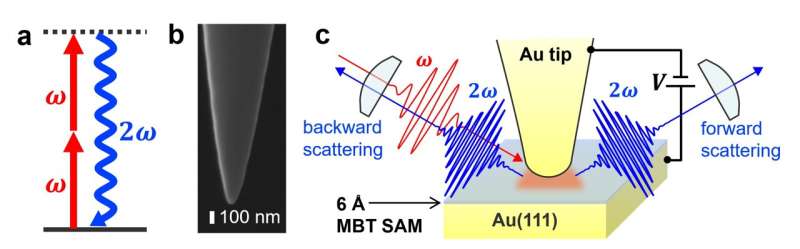
Researchers at the Institute for Molecular Science (NINS) in Japan, in collaboration with SOKENDAI, have reported a remarkable advancement in nonlinear optics. Their study, published on February 3, 2026, in the journal Nature Communications, outlines a method that achieves over a 2,000% increase in light output per volt by utilizing an angstrom-scale plasmonic gap. This breakthrough has the potential to transform the field of electro-photonic devices.
The team demonstrated that by manipulating a voltage across a metallic tip and substrate in a scanning tunneling microscope (STM), they could significantly enhance the near-field nonlinear optical responses. Specifically, they observed a quadratic relationship between the applied voltage, varying within ±1 V, and the intensity of second-harmonic generation (SHG). This led to a modulation depth of approximately 2000%/V, marking a significant improvement over previous electroplasmonic systems.
Mechanism Behind the Breakthrough
The researchers attribute this extraordinary modulation effect to the intense electrostatic fields generated within the angstrom-scale gap. Typically, applying voltage across two electrodes produces an electrostatic field between them. In this case, the field strength, which diminishes with increasing distance, becomes extraordinarily high due to the small gap size. Just a 1 V application across this few-angstrom gap results in electrostatic fields nearing 10^9 volts per meter. These extreme fields modify the electronic states of nearby molecules, greatly enhancing their nonlinear optical responses.
Previous plasmonic structures, which usually range from tens to hundreds of nanometers in size, have not been able to achieve such levels of electrical control. The findings signify a new frontier in the field, offering a platform for the precise manipulation of light at an unprecedented scale.
Future Directions and Implications
Dr. Shota Takahashi, an Assistant Professor at NINS, remarked, “This work shows that angstrom-scale metal gaps serve as a powerful platform for electrically controlling nonlinear light generation processes with large modulation depth.” He emphasized that these advancements could lead to the development of next-generation ultra-compact electro-photonic devices where electrical and optical signals are processed at extremely small spatial scales.
Dr. Toshiki Sugimoto, Associate Professor and principal investigator of the project, indicated plans to explore nonlinear optical materials with stronger electric-field responsiveness. He also mentioned the intention to develop a more comprehensive theoretical framework for understanding electrical modulation mechanisms in angstrom-scale settings. Such efforts are anticipated to propel advancements across various disciplines, including nonlinear optics, nanophotonics, condensed matter physics, and electronic engineering.
The implications of this research extend beyond the laboratory. As the technology matures, it could pave the way for practical applications in telecommunications, sensing, and advanced imaging systems, fundamentally altering how optical and electronic signals interact in future technologies.
For further details, refer to the original research: Shota Takahashi et al, “Giant near-field nonlinear electrophotonic effects in an angstrom-scale plasmonic junction,” Nature Communications, 2026. DOI: 10.1038/s41467-026-68823-4.