Jimmy Lai, a prominent pro-democracy advocate and former media tycoon in Hong Kong, received a 20-year prison sentence on March 15, 2024. This ruling marks the longest punishment imposed under the national security law enacted by Beijing, a law that has severely curtailed dissent in the city. Lai, aged 78, was convicted in December 2023 of conspiring to collude with foreign forces to endanger national security and of conspiracy to publish seditious articles.
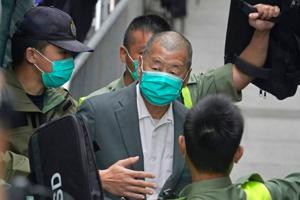
The maximum penalty for Lai’s charges could have been life imprisonment. Alongside him, six former employees of his now-defunct newspaper, Apple Daily, and two activists faced prison terms ranging from six years and three months to ten years for similar collusion-related offenses. The sentencing took place in a courtroom where emotions ran high, with supporters visibly distressed as Lai was led away.
Upon his arrival, Lai smiled and waved to supporters, but his demeanor shifted to solemnity as he left. When asked if they would appeal the sentence, Lai’s lawyer, Robert Pang, declined to comment. The trial and subsequent sentencing have raised significant concerns regarding press freedom in Hong Kong, once viewed as a bastion of media independence in Asia.
Government’s Justification and International Reactions
The Hong Kong government has asserted that the case against Lai is not related to press freedom, claiming that the defendants exploited journalism as a cover for actions detrimental to national security. Lai was among the first high-profile figures arrested under the security law in 2020, a law that has since triggered a crackdown on many leading activists in the region.
Internationally, Lai’s conviction has drawn criticism from foreign governments. U.S. President Donald Trump, who is slated to visit China in April, expressed his dismay at the verdict, stating he had urged Chinese leader Xi Jinping to consider Lai’s release. Similarly, U.K. Foreign Secretary Yvette Cooper described the prosecution as politically motivated, while Australian Foreign Minister Penny Wong expressed grave concerns over the implications of the sentencing.
Lai’s son, Sebastien Lai, condemned the prison term as “draconian,” indicating it poses life-threatening risks to his father. He stated, “It signifies the total destruction of the Hong Kong legal system and the end of justice.” His sister, Claire Lai, echoed this sentiment, characterizing the sentence as “heartbreakingly cruel” and warned that if enforced, it would turn Lai into a martyr.
Legal Context and Broader Implications
The ruling has raised alarms regarding the interpretation of seditious intent and the application of the term “collusion with foreign forces,” particularly concerning media activities. According to Urania Chiu, a law lecturer at Oxford Brookes University, this broad interpretation could have chilling effects on journalists and academics, as legitimate critiques of the state may now be construed as acts of collusion.
Lai, who founded Apple Daily in 1995, has been incarcerated for over five years. He suffers from various health issues, including heart palpitations and diabetes, although the prosecution has claimed that his overall health remains stable. The judges noted that while Lai’s age and health warranted some leniency, he was still deemed the “mastermind” behind the conspiracies, justifying a heavier sentence.
The former employees of Apple Daily and the activists involved had previously entered guilty pleas, which contributed to the reduction of their sentences. Their cooperation with the prosecution was highlighted by the judges as significant in securing Lai’s conviction.
The harsh sentence has sparked further discussions about press freedom in Hong Kong, which has dropped to 140th out of 180 territories in the global press-freedom index compiled by Reporters Without Borders, a stark fall from its 18th position in 2002. The government has announced plans to confiscate assets linked to Lai’s crimes, underscoring the ongoing tensions between Hong Kong’s authorities and advocates of democratic freedoms.
As the case unfolds, it continues to symbolize the broader struggle for freedom of expression in Hong Kong, raising critical questions about the future of civil liberties in the region.