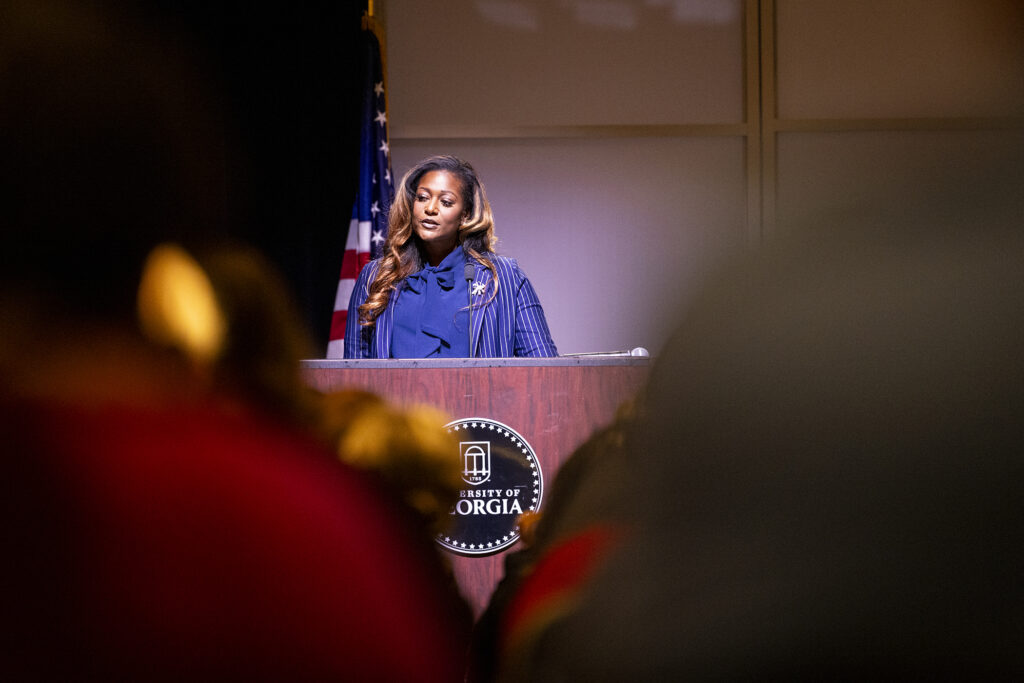
The 26th annual Mary Frances Early Lecture at the University of Georgia on February 9, 2024, highlighted the profound impact of Early’s legacy as the institution’s first African American graduate. The event featured keynote speaker Adrienne Madison, a prominent research biomedical engineer at the U.S. Army Aeromedical Research Laboratory, who shared her personal journey of achievement and the inspiration drawn from Early’s pioneering spirit.
In her address, Madison emphasized the theme of “bloom,” reflecting on her own academic and professional growth. She articulated, “Today, in this setting, I ask you to grant me the courtesy of being viewed as one of the branches from Ms. Early’s tree — a brilliant bloom rising from the soil enriched with her grit.” Madison’s achievements include being the College of Engineering’s first doctoral graduate, earning a Ph.D. in biological and agricultural engineering in 2013.
Madison’s path to success was not without challenges. She recalled the “highs, lows, and defining moments” she faced throughout her education, noting the dual necessity of “rain and sunshine” for growth. Her drive to pursue biomedical engineering was fueled by her desire to assist her grandmother during health complications. Following her grandmother’s passing, Madison sought guidance from her high school counselor to find a major that combined her interests in medicine, science, and engineering. “Biomedical engineering was my destiny,” she stated, underscoring her commitment to honoring her grandmother’s memory through her work.
The lecture also served as a platform for Madison to advocate for mentorship as a vital tool for progress. She remarked, “Mentorship is an essential catalyst for progress — a crucial step that ensures a community’s growth remains unbroken.” By guiding the next generation, Madison aims to contribute to the legacy established by trailblazers like Early, who laid the groundwork nearly 64 years ago.
In a poignant moment, Madison shared a personal connection to Early’s legacy. During her doctoral studies, Madison received a handwritten letter from Early, who had reached out to graduating students to encourage them. This gesture provided Madison with the motivation she needed during a challenging time in her research. “That note was the encouragement I needed,” she reflected, illustrating the enduring influence of Early’s support.
Early, who integrated the University of Georgia as its first African American graduate student in 1961, expressed pride in the university’s progress. “I came here to help encourage others,” she stated during the lecture. Her journey, which began with her enrollment alongside the first African American undergraduate students, Charlayne Hunter-Gault and the late Hamilton Holmes, culminated in her becoming the institution’s first African American graduate in 1962.
Alton Standifer, vice provost for academic and community engagement, echoed Early’s sentiments, urging attendees to remember both their roots and their potential. He quoted her wisdom, reminding the audience that “your roots will remind you from whence you came and your wings will take you to unbelievable heights if you believe in yourself.”
The Mary Frances Early Lecture series aims to honor Early’s dedication to creating an inclusive academic environment and to acknowledge the strides made toward achieving her vision. Jere W. Morehead, President of the University of Georgia, remarked on Early’s lasting impact, stating, “Your legacy has had a lasting impact on generations of students who all follow in your footsteps.”
Sponsored by the Graduate School, Graduate and Professional Scholars, the Mary Frances Early College of Education, the Office of Academic and Community Engagement, and the Office of the President, this lecture not only celebrates Early’s contributions but also serves as a reminder of the ongoing journey toward equality and inclusion in higher education.