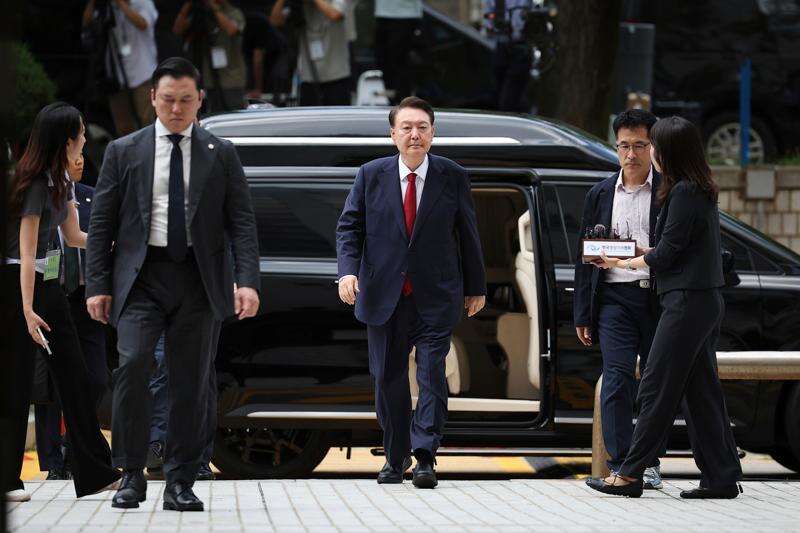
BREAKING: Former South Korean President Yoon Suk Yeol has been sentenced to life in prison for his controversial imposition of martial law in December 2024. The Seoul Central Court found Yoon guilty of rebellion, concluding he illegally mobilized military forces in an attempt to seize control of the National Assembly and suppress political opposition.
The ruling was handed down by Judge Jee Kui-youn, who emphasized the gravity of Yoon’s actions, which were deemed a significant threat to South Korea’s democracy. Yoon’s defense team has indicated plans to appeal this verdict. Earlier, a special prosecutor had sought the death penalty, stating that Yoon’s actions warranted the harshest punishment available due to the potential damage to democratic processes. However, analysts anticipated a life sentence, as the poorly executed power grab resulted in no casualties.
As Yoon arrived at the courthouse, a heavy police presence monitored the situation, with supporters rallying outside the judicial complex. Their chants grew louder as the prison bus transporting Yoon passed by, while critics demanded the death penalty for his actions.
In addition to Yoon, several former military and police officials have been convicted for their roles in enforcing the martial law decree. Notably, ex-Defense Minister Kim Yong Hyun received a 30-year prison term for orchestrating the military mobilization. Yoon’s martial law decree lasted just six hours before lawmakers managed to break through a military blockade and unanimously voted to revoke it.
Yoon, a staunch conservative, defended his decree as essential to thwarting what he termed “anti-state” liberal forces, asserting that his agenda was jeopardized by their legislative majority. He was suspended from office on December 14, 2024, following impeachment by lawmakers, with the Constitutional Court formally removing him from office in April 2025. Since his arrest last July, he has faced multiple criminal trials, with the rebellion charge carrying the most severe consequences.
In a previous ruling, Yoon was sentenced to five years for charges including resisting arrest and fabricating the martial law proclamation. The court also convicted two of his Cabinet members, including Prime Minister Han Duck-soo, who received a 23-year sentence for attempting to legitimize the decree through falsified records and misleading testimony, and has since appealed his verdict.
This urgent legal battle underscores the ongoing tensions within South Korea’s political landscape, raising questions about the future of democracy in the country. As the situation develops, many are left wondering how this landmark ruling will impact the nation’s political climate and the future of democratic governance in South Korea.
Stay tuned for more updates as details continue to emerge from this high-stakes case.