Hundreds of students from various educational levels gathered at the College of Southern Maryland (CSM) in January and February 2026 to participate in a series of exciting VEX Robotics competitions. The events featured tournaments specifically designed for elementary, middle school, high school, and college teams, showcasing the engineering skills of the next generation.
At the CSM La Plata Campus, the competitions allowed participants to demonstrate their abilities in designing, building, testing, and operating robots. The focus was on completing task-based challenges that encouraged teamwork, problem-solving, and critical thinking. More than 20 elementary and middle school teams competed in the VEX IQ tournament on January 24, while over 30 regional high school teams filled the CSM Physical Education Center on February 7 to showcase their robots.
The Talons Robotics Team played a vital role in supporting both competitions, serving as referees, scorekeepers, and judges. Their leadership provided mentorship to younger participants, fostering a collaborative environment. Notably, the Talons team excelled at the college-level competition on February 6, winning every match and outscoring four other teams from four-year universities.
Team member Alexander Hawe expressed his excitement about the victory, describing it as a significant confidence boost. “After some setbacks and a full redesign from the robot we had in Manassas, I’m glad that it went well and it all paid off,” he stated, reflecting on the team’s hard work since a previous tournament in November.
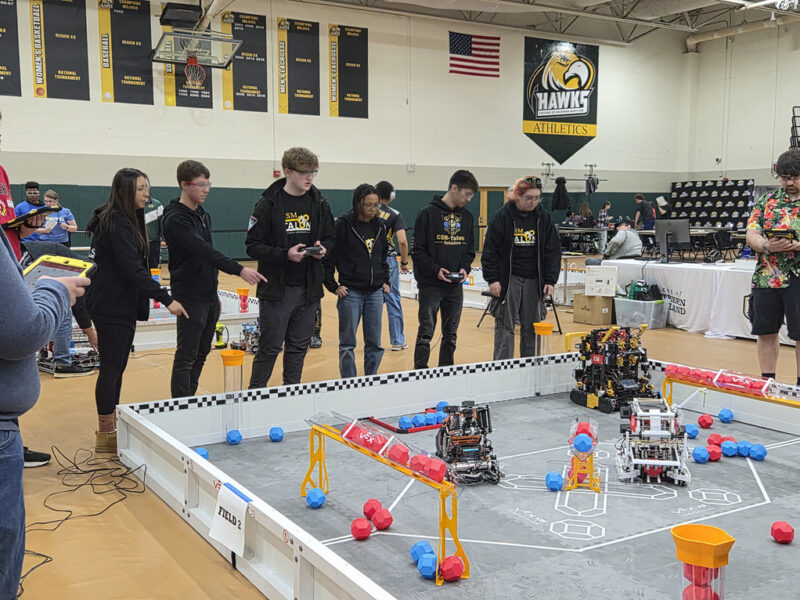
Each year presents a new challenge for competitors, and this year’s game field for university and high school tournaments is called Push Back. This setup features tall cylinders filled with red and blue balls positioned at each corner of the field. Teams aim to score points by moving these balls into one of three goals: one central and two on opposite sides.
The competition for elementary and middle school teams is named Mix and Match, where teams score points by stacking different colored pins around a tall central goal. Hawe noted that these competitions enhance his engineering skills by providing practical experience in real-world challenges. “You can go to class and get good grades, but to be a good engineer you need to apply your skills somewhere,” he explained.
Another team member, Michael McGrath, highlighted the importance of early exposure to robotics in shaping future engineers. “They’re going to be the next generation of engineers. Hands-on experience at an early age helps them develop an interest in engineering, get started along that path, and build their skills,” he said. As a sophomore engineering student planning to transfer to the University of Maryland for mechanical engineering, McGrath noted that the Talons team has provided him with invaluable, hands-on experience.
Looking ahead, the Talons have two more competitions this spring, aiming to secure a spot at the World Championships in May. These events were made possible through the efforts of CSM faculty, staff, volunteers, and community partners, including Professors Ann Stine and Eugen Leontie, whose coordination helped attract hundreds of aspiring engineers to campus.
The enthusiasm, innovation, and teamwork displayed at CSM’s robotics competitions serve as a reminder of the potential and promise that young engineers hold for the future.