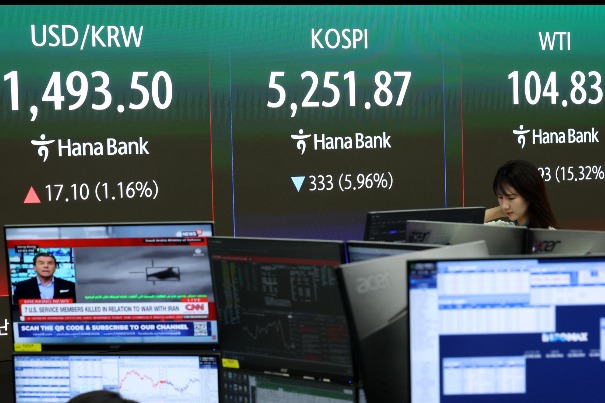
UPDATE: South Korean stocks have plunged dramatically today, with the Kospi index crashing over 8% during trading, triggering a 20-minute circuit breaker, as investors scramble for safety amidst escalating tensions in the US-Israel-Iran conflict. The benchmark Kospi fell to 5,251.87 by market close, a stark drop from earlier lows below 5,100.
This catastrophic downturn comes just days after a record rebound in Korean equities, highlighting the market’s volatility and fears of a W-shaped recovery rather than a straightforward comeback. The tech-heavy Kosdaq also suffered, closing down 4.5% at 1,102.28.
Investors reacted swiftly to a surge in oil prices, with West Texas Intermediate crude reaching $114.49 per barrel—up nearly 26%—the highest since July 2022. This spike is particularly damaging for South Korea, which heavily depends on Middle Eastern energy imports.
“A spike in oil prices amid a closure of the Strait of Hormuz could intensify risk-averse sentiment toward the country’s manufacturing-heavy, oil-intensive stock market,” said Lee Sung-hoon, an analyst at Kiwoom Securities Co.
The won has also weakened significantly, trading at 1,495.50 won per dollar, nearing the psychologically important 1,500 threshold. This marks its lowest level since March 12, 2009, during the global financial crisis. Foreign investors led the sell-off, offloading a net 3.2 trillion won (approximately $2.1 billion) of shares, while institutions sold 1.5 trillion won.
Among the most affected companies, SK Hynix dropped 9.5%, Hyundai Motor Co. lost 8.3%, and Samsung Electronics fell 7.8%. The broader sell-off has significantly impacted household names and growth stocks alike, indicating deepening concerns over market stability.
The turmoil isn’t isolated to South Korea. Global markets are feeling the strain, with the Dow Jones Industrial Average down nearly 1% as investors grapple with rising oil prices and disappointing labor data from the U.S.
Analysts are divided on what lies ahead. While some believe the current levels reflect an oversold market, others warn that the ongoing geopolitical crises could lead to further volatility rather than a rapid recovery. “In past episodes of sharp market declines, a V-shaped rebound has been rare,” noted Lee Eun-taek from KB Securities Co..
As the situation develops, traders and investors are urged to stay vigilant. The next few days could prove critical for both the South Korean economy and global markets as they navigate these unprecedented challenges.