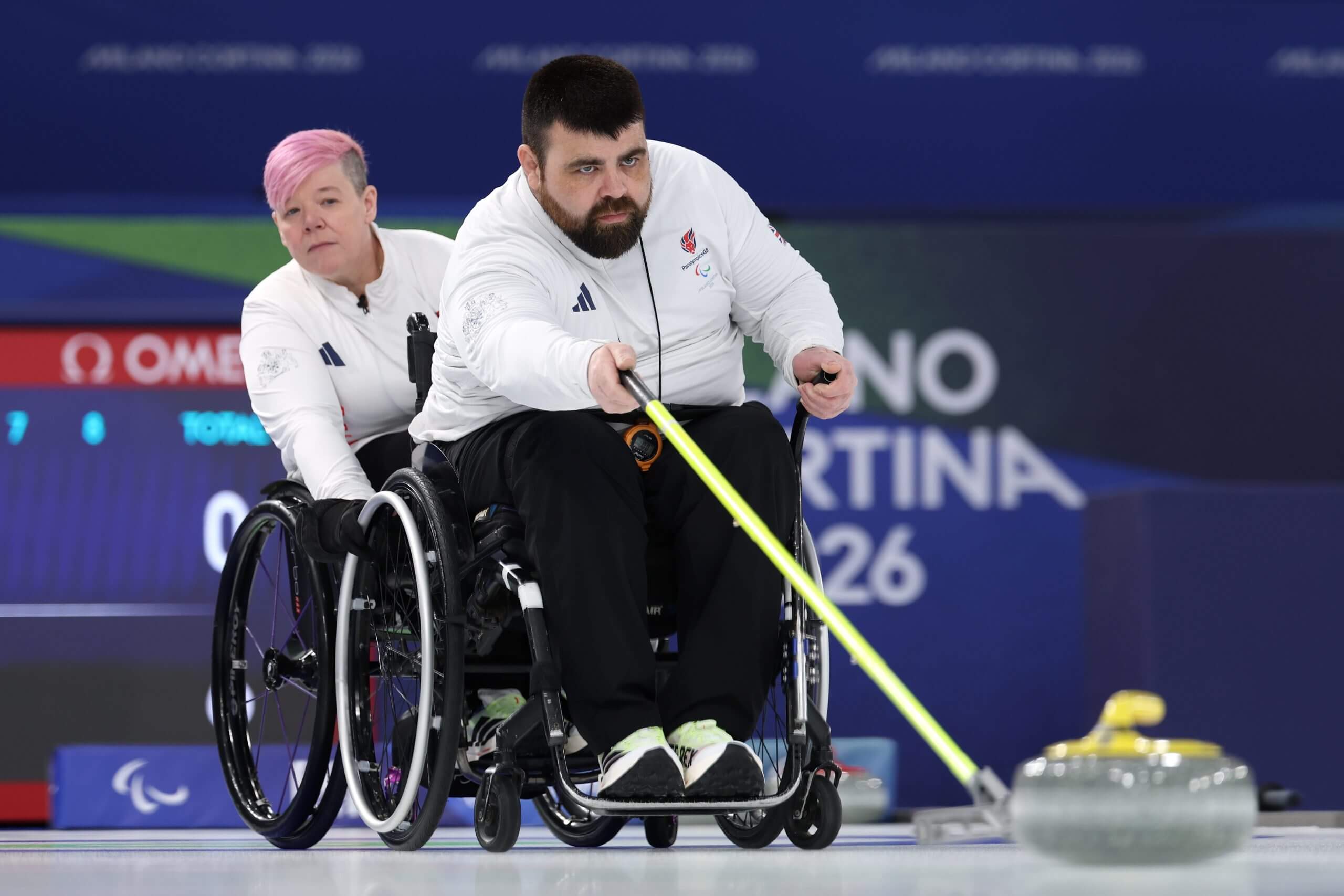
CORTINA D’AMPEZZO, Italy — In a sport where precision is paramount, wheelchair curling athletes have demonstrated remarkable skill and strategy during the ongoing Paralympic Games. Stewart Pimblett, who plays third for Great Britain’s mixed team, emphasized the unique nature of the sport, stating, “Once we release, it’s in the lap of the gods.”
Unlike Olympic curling, wheelchair curling does not allow for sweeping, a critical technique employed by Olympic athletes to influence the stone’s trajectory. Instead, players use a long stick, reaching up to 2.13 meters, to deliver the stone while a teammate or volunteer stabilizes their position. “It’s the sweepers who make it a good shot,” said Austin McKenzie, GB’s vice-skip, highlighting the increased skill required in wheelchair curling.
The differences in gameplay are evident in performance metrics. A 2006 study by the University of Edinburgh found that sweeping could enhance shot distance by as much as 10 percent in Olympic curling. In the current Paralympic competition, the top-performing team, China, has achieved a 65 percent success rate, while many teams have executed their throws only about half the time.
The stones used in both the Olympic and Paralympic events are nearly identical, sourced from only two facilities. This consistency raises questions about the performance discrepancies. As American wheelchair curler Steve Emt noted, “There’s a difference between being an athlete and being athletic.” The mental aspect of the game plays a critical role, with athletes needing to focus intensely on their shots without the aid of sweeping.
Different teams adopt varied strategies during play. For instance, the Italian pair of Orietta Berto and Paolo Ioriatti prefer to work closely, often positioning themselves one behind the other to provide support. This cooperation is essential, as athletes with limited lower-limb functionality rely heavily on their teammates. Jo Butterfield, a member of the GB mixed doubles team, expressed gratitude for the volunteers who assist in stabilizing the athletes during throws. “We like to chat, we support each other in that way,” she said.
The dynamics of teamwork were on full display during a tense round-robin match between the United States and Italy, where the game hinged on the final stone. With Italy trailing 6-5, they required a point to force an extra end. After a series of strategic throws, the match concluded with a crucial shot from Laura Dwyer of Team USA, securing a victory for her team.
Notably, the efficiency of final stone shots—those made with the hammer—remains lower in wheelchair curling compared to the Olympic standard. The frequency of stolen ends, where teams score points despite their opponents having the last throw, is higher, indicating a distinct competitive landscape.
One of the standout moments of the tournament thus far came from Canada’s Jon Thurston, who executed a remarkable shot that cleared multiple stones from the house, setting his team up for a decisive six-point end. Ina Forrest, his teammate, described the execution as a perfect blend of skill and precision, crucial in a sport where “one super-good shot makes a big difference.”
Training for wheelchair curling involves rigorous upper-body workouts designed to enhance strength and stability. Athletes focus on various exercises, including cable pulls and bench presses, while also honing their mental game. “We’ve done a lot of training with eye tracking,” said Jason Kean of Team GB, emphasizing the importance of visual focus during throws.
As the tournament progresses, the psychological aspects of competition remain at the forefront. Emt discussed the importance of maintaining a balanced state of arousal, recommending a level of four or five out of ten for optimal performance. This mental approach extends to their pre-shot routines, which include techniques for grounding and focus.
The unique characteristics of wheelchair curling, along with the athletes’ dedication and skill, continue to captivate audiences at the Paralympic Games. While distinct from its Olympic counterpart, the sport showcases the incredible talent and resilience of athletes who compete under challenging circumstances. The journey through Cortina d’Ampezzo not only highlights the physical demands of wheelchair curling but also celebrates the mental fortitude and teamwork that define this remarkable sport.