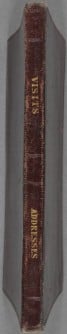
The National University of Singapore (NUS) has published Charles Darwin’s personal Address Book for the first time, offering an unprecedented glimpse into the life of the famed naturalist. This small leather notebook, spanning only 48 pages, contains approximately 500 entries and showcases Darwin’s extensive network of personal and professional contacts.
Darwin’s Address Book began shortly after his marriage to Emma Darwin in January 1839, when they settled in London. The notebook later accompanied them to their home in Down, Kent, in 1842, where Darwin continued to document names, addresses, and other valuable information throughout his lifetime. This publication, part of the Darwin Online project, includes expertly transcribed entries, editorial notes, and links that help identify the individuals referenced within the context of Darwin’s extensive body of work.
One significant aspect of the Address Book is its inclusion of contacts not found in the comprehensive Darwin correspondence project, which produced 30 volumes covering 15,000 surviving letters. This project, while monumental, does not capture the multitude of other connections that existed during Darwin’s lifetime. The Address Book thus serves as a remarkable piece of social history, revealing not only names and addresses but also unique references to research materials and personal notes.
Among the entries are various contacts, including pigeon breeders, tradesmen, and even the optician who provided eyewear to Queen Victoria and later to Winston Churchill. One particularly intriguing entry relates to Darwin’s correspondence with Alfred Russel Wallace, whose shipping agent in Singapore is noted in the book. This connection is significant, as both Darwin and Wallace independently developed the theory of evolution by natural selection, leading to a joint presentation of their findings in 1858, which preceded the publication of Darwin’s groundbreaking work, On the Origin of Species, on November 24, 1859.
The notebook also contains practical information about Darwin’s interests and daily life, including recipes for rat poison, methods for cleaning animal skeletons, and buying a fireworks display for his village. Notes on medical treatments and various purchases, such as scientific labels and gardening supplies, further illustrate Darwin’s diverse pursuits beyond his well-known scientific endeavors.
Dr. John van Wyhe, a historian of science at NUS, emphasized the significance of this publication, stating, “It’s incredible that this little treasure-trove of details by Darwin has remained unpublished until now. It offers fascinating new insights into his life and the way he worked.” Since its inception in 2005, the Darwin Online project has aimed to digitize and make accessible the entirety of Darwin’s archive, and this latest addition enhances our understanding of a figure whose impact on science and society remains profound.
The Address Book can be accessed online, providing a valuable resource for researchers and enthusiasts alike who wish to explore the personal connections of one of history’s most influential figures. The meticulous transcription and editing process ensures that this rich piece of history is preserved for future generations.