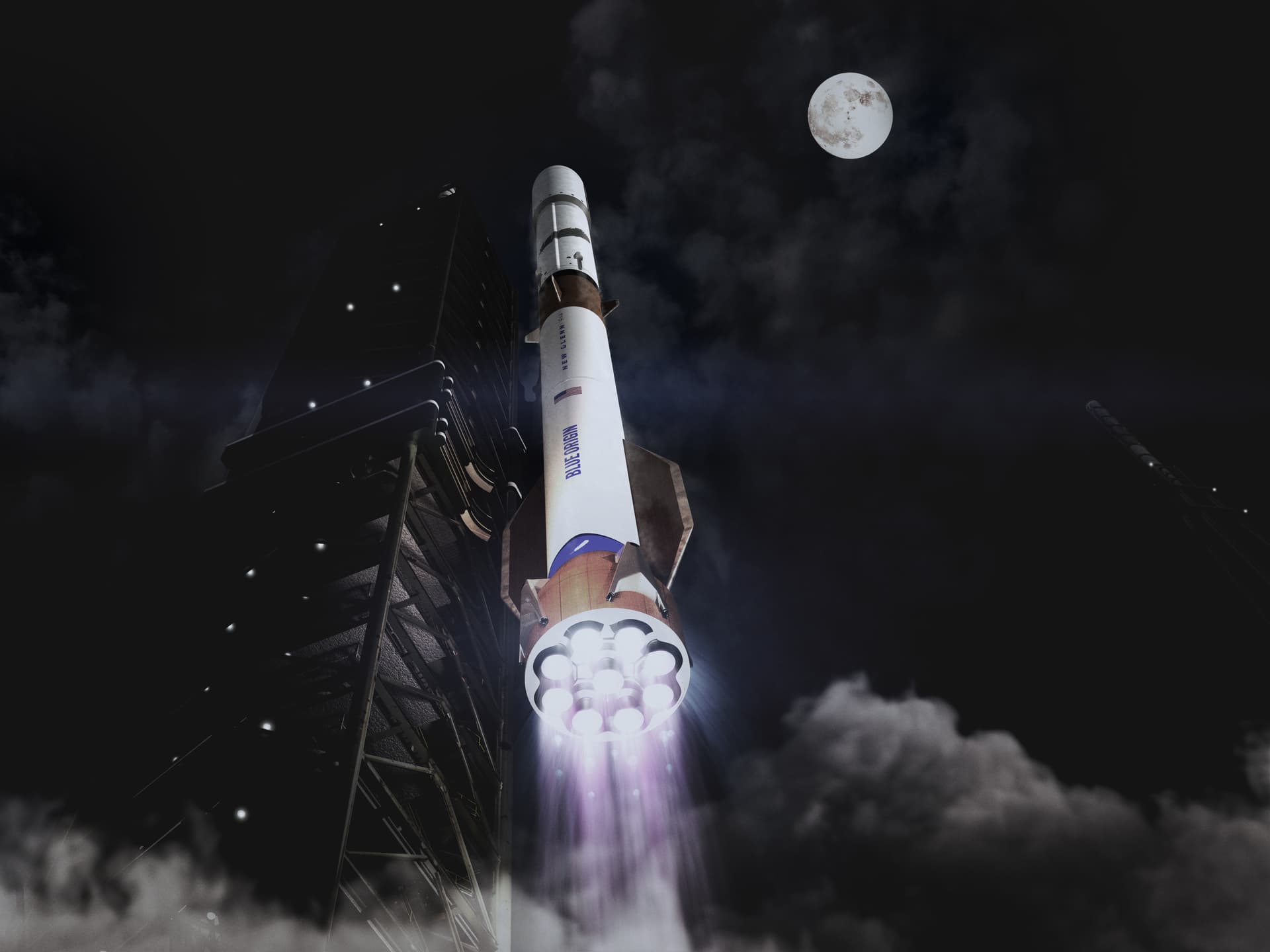
Blue Origin has made significant strides in the space industry with its latest heavy-launch vehicle, the partially reusable New Glenn rocket. On November 13, 2023, during the second launch of the New Glenn rocket (designated NG-2), the company successfully deployed a NASA payload headed for Mars. This mission, known as ESCAPADE (Escape and Plasma Acceleration Dynamics Explorers), involves two twin satellites that will investigate how solar wind interacts with Mars’ magnetic environment and contributes to atmospheric escape.
The recent launch also marked a milestone for Blue Origin as it successfully retrieved the rocket’s first stage, further demonstrating the company’s commitment to achieving partial reusability in its launch systems. In a statement released shortly after the launch, Blue Origin outlined plans for future enhancements to the New Glenn rocket, which will include upgrades in propulsion, avionics, reusability, and recovery.
Plans for a Super Heavy Version
In an ambitious move, Blue Origin announced its intention to develop a “super-heavy” version of the New Glenn rocket, which is projected to position it as a competitor to SpaceX’s Starship. The enhancements will involve high-performing thrusters for both the first and upper stages. Currently, the New Glenn utilizes seven BE-4 booster engines that generate 2,400 kN (550,000 lbf) of thrust at sea level, totaling 16,800 kN (3.5 million lbf). The upgraded engines are expected to deliver 2,847 kN (642,850 lbf) each, raising the total thrust to approximately 19,928 kN (4.5 million lbf).
Blue Origin has already demonstrated capabilities of up to 2,780 kN (625,000 lbf) on the test stand and is aiming for the new BE-4 engines to be operational by the next launch, NG-3. The enhanced BE-3U thrusters, which power the upper stage, will also see an increase in capacity, moving from the original design of 1,423 kN (320,000 lbf) to 1,779 kN (400,000 lbf).
The new super-heavy variant, referred to as the New Glenn 9×4, will utilize nine engines—four BE-4 engines for the first stage and five BE-3U engines for the upper stage. Additionally, it will feature a larger payload fairing measuring 8.7 meters (approximately 28 feet 6.5 inches) in diameter, an increase from the current 7-meter (23-foot) fairing. This new design will allow the rocket to deliver up to 70 metric tons to Low Earth Orbit (LEO), 14 metric tons to Geosynchronous Orbit (GSO), and 20 metric tons to a Trans-Lunar Injection (TLI) for missions to the Moon.
Strategic Moves in the Commercial Launch Market
Blue Origin’s initiatives are part of a broader strategy to enhance rocket performance and increase launch frequency, ensuring competitiveness in the rapidly evolving satellite launch market. The global space launch industry is projected to reach a value of $35.95 billion by 2030, making it crucial for companies to innovate and differentiate themselves.
In addition to its commercial endeavors, Blue Origin is set to provide crew and payload services through NASA’s Artemis Program, specifically for missions Artemis V and VI. The implications of the U.S. government’s FY 2026 Budget Request suggest potential changes in NASA’s approach to space exploration, especially with discussions around the cancellation of the Space Launch System (SLS) and the Orion spacecraft. This shift may lead to increased reliance on private sector capabilities for launch and crewed spacecraft needs.
Recent announcements from acting NASA Director Sean Duffy indicate that the agency will seek competitive bids for the Human Landing System (HLS), largely due to delays in the development of SpaceX’s Starship. Blue Origin aims to secure additional contracts with NASA for deep space exploration missions, similar to the ESCAPADE project, as well as national security programs like Golden Dome.
With the launching of the New Glenn rocket, Blue Origin is not only marking a significant achievement in space exploration but also positioning itself as a key player in an industry poised for exponential growth. The company’s strategic enhancements and new developments signal its commitment to pushing the boundaries of space technology and exploration.