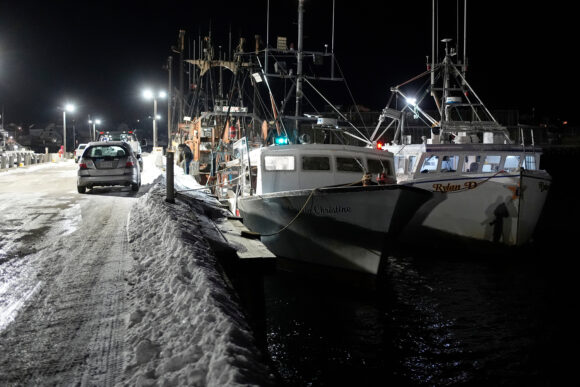
The U.S. Coast Guard has suspended its search for seven crew members of the commercial fishing vessel Lily Jean, which sank approximately 25 miles (40 kilometers) off Cape Ann, Massachusetts. The decision was made on Saturday after extensive search efforts revealed a debris field, an empty life raft, and one body in the water, but no signs of the missing individuals.
The rescue mission commenced early on Friday, January 30, 2026, following an emergency alert from the 72-foot (22-meter) vessel. Search teams covered around 1,000 square miles (2,589 square kilometers) over a 24-hour period, utilizing aircraft, cutters, and small boats to scour the area. Despite these efforts, the Coast Guard determined that all reasonable search operations had been exhausted after consulting with mission coordinators and on-scene commanders.
No distress call was issued by the Lily Jean as it navigated the treacherous waters of the Atlantic on its return journey to Gloucester, known as America’s oldest fishing port. Instead, the Coast Guard was alerted by the vessel’s beacon, which activates when it enters the water. An investigation into the cause of the sinking is currently underway, although officials have not yet released the names of the missing crew members.
Challenging Conditions Hampered Search Efforts
Coast Guard Sector Boston commander Jamie Frederick highlighted the difficult weather conditions that hindered search operations. Frigid temperatures and stormy seas complicated the mission, particularly with an approaching nor’easter expected to strike the East Coast over the weekend. Search teams faced waves reaching 7 to 10 feet and freezing ocean spray, while wind speeds were recorded at approximately 27 mph (24 knots). At the time of the emergency alert, air temperatures were around 12 degrees Fahrenheit (minus 11 degrees Celsius), with water temperatures hovering near 39 F (4 C).
Frederick remarked that there was “no single clue” to uncover what had transpired with the Lily Jean. He described the debris as common items found on a fishing vessel’s deck, which further complicates the investigation into its sinking.
A Close-Knit Community in Mourning
The tragedy has struck a profound chord within the tight-knit fishing community of Gloucester, a city with a rich maritime history. Republican state senator Bruce Tarr expressed the community’s sorrow during an emotional news conference, stating, “We are deep in sorrow, but we are a strong community, and we will rise, we will rise to this occasion.”
The loss of the Lily Jean and its crew adds to the list of maritime tragedies that have affected Gloucester, a city famously linked to the book and film “The Perfect Storm.” The FV Andrea Gail, which inspired the narrative, was lost at sea in 1991. Vito Giacalone, head of the Gloucester Fishing Community Preservation Fund, reflected on the impact of the incident, noting that the community is “heartbroken.” He emphasized the magnitude of the loss, stating, “To have that many lives lost all at once, we haven’t seen that in a long time.”
The city’s mayor, Paul Lundberg, announced that the names of the crew members would be added to a city memorial honoring the thousands of fishermen who have tragically lost their lives at sea.
The Lily Jean was captained by Gus Sanfilippo, a fifth-generation fisherman known for his dedication to the trade. He and his crew were featured in a 2012 episode of the History Channel show “Nor’Easter Men.” Sanfilippo was renowned for his commitment to fishing out of Gloucester, often enduring perilous conditions for extended periods while pursuing species such as haddock, lobster, and flounder.
The National Oceanic and Atmospheric Administration (NOAA) confirmed that a fishery observer was on board the Lily Jean at the time of its sinking. Fishery observers collect vital data for regulatory purposes. Following this incident, NOAA Fisheries announced a suspension of observer deployments until after midnight on Wednesday due to prevailing weather conditions in the Northeast.
Deep-sea fishing remains one of the world’s most hazardous professions, especially in New England during the winter months, characterized by high waves and unpredictable weather. Local resident Everett Sawyer, a childhood friend of Sanfilippo, expressed the challenges faced by commercial fishermen, stating, “Things happen very quickly when you’re out on the ocean.” He emphasized that he has known 25 people who have been lost at sea, underscoring the inherent dangers of this profession.
As the community of Gloucester grapples with this devastating loss, further details regarding the investigation into the sinking of the Lily Jean are anticipated in the coming days.