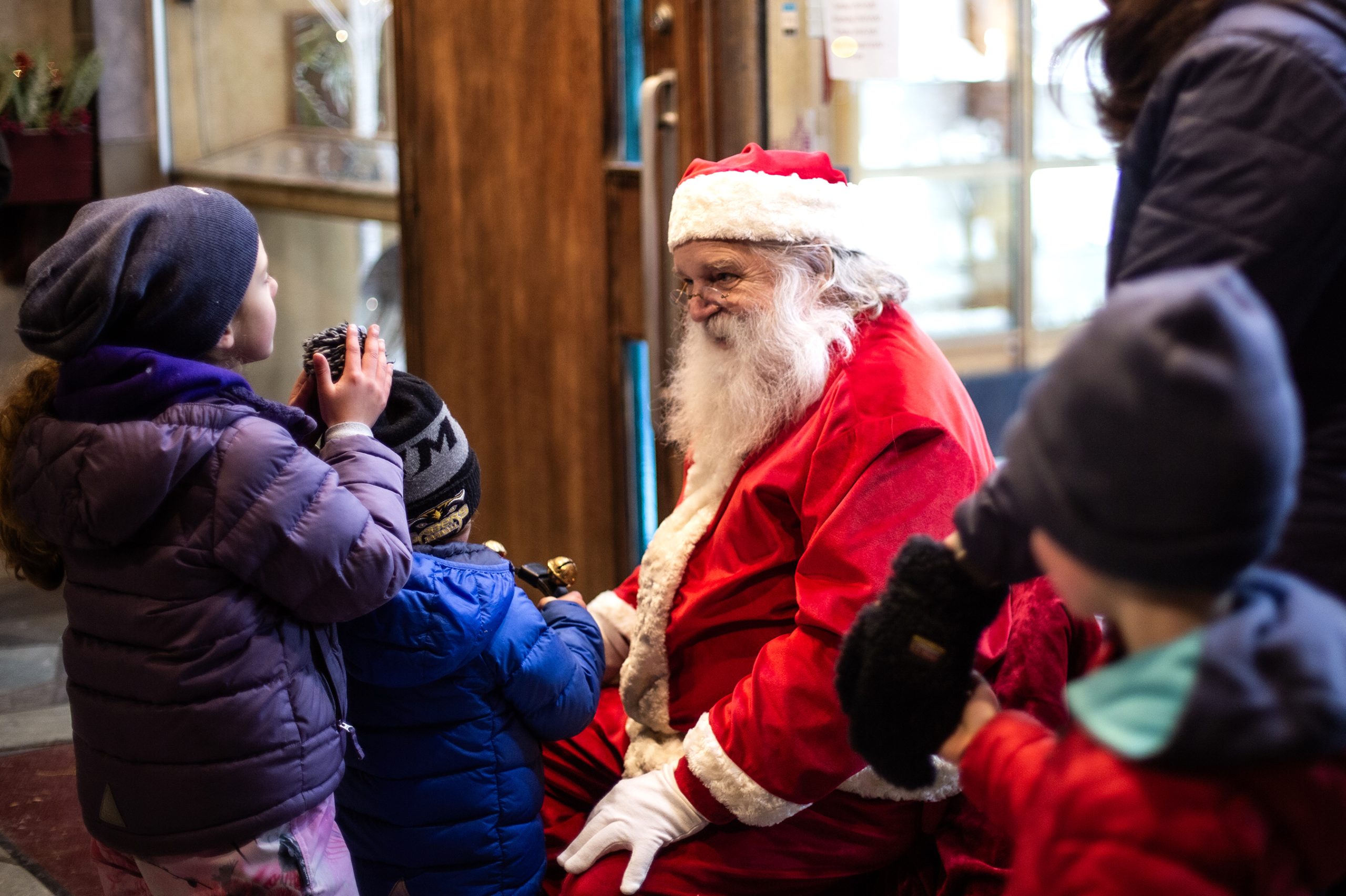
Santa Claus, the beloved figure embodying holiday cheer, recently engaged with children during a festive event known as Midnight Merriment on December 5, 2025. As he listened to their Christmas wishes, an intriguing question emerged: Could Santa use artificial intelligence (AI) to enhance the efficiency of his legendary gift delivery?
For centuries, Santa has operated a complex global logistics network, managing the distribution of presents to millions of children in a single night. The challenge is monumental, involving not only moral and physical considerations but also significant mathematical complexities. The task of determining the most efficient route to visit approximately one billion homes falls under the renowned mathematical challenge known as the Traveling Salesman Problem, particularly its time-constrained variant.
Wheeler Ruml, a professor of computer science at the University of New Hampshire, explained that finding an optimal route for Santa is not feasible due to the problem’s inherent complexity. “Finding a provably optimal solution to a problem of Santa’s size is beyond our capabilities,” Ruml stated. “But there are families of algorithms called approximation algorithms that can yield solutions that are guaranteed to be close to optimal.”
In practical terms, this means Santa could potentially utilize approximation algorithms to process billions of GPS coordinates through a hypothetical system, cleverly dubbed the Binary Logarithmic Internet-Tracked Zoomorphic Electronic Numbercruncher (BLITZEN). Such a system would generate a sufficiently efficient route, allowing Santa to maximize his time and reach every child while minimizing travel distance.
The concept of BLITZEN, while whimsical, highlights how contemporary technologies, often referred to as AI, can indeed perform complex calculations and pattern matching at remarkable speeds. As society advances, the notion that Santa could enlist the help of tech-savvy elves, skilled in programming languages like Python, R, and C++, to develop a more efficient gift delivery system becomes increasingly feasible.
Imagining further innovations, one might even speculate about Santa employing robotic helpers to navigate through chimneys, allowing him to relax while technology takes on some of the heavy lifting. This playful idea reflects society’s growing integration with AI across various sectors.
Despite these entertaining possibilities, the essence of Santa’s mission remains rooted in the spirit of giving and the personal effort involved in gift-giving. The notion of using AI to simplify the Christmas experience may undermine the heartfelt nature of the holiday. As Ruml humorously noted, “Using AI to make it easy to give Christmas presents would be as counter-productive as using AI to do your homework.”
As the festive season approaches, the conversation around Santa and AI encourages reflection on the balance between tradition and technology. Ultimately, the joy and warmth of the holidays stem from personal connections and the effort invested in caring for others.
In the spirit of the season, let us embrace the essence of Christmas—“Merry Happy Christmas and may your heart grow three sizes.”