Before the introduction of the wireless television remote control, viewers had to physically interact with their TV sets to change channels or adjust volume. This laborious task often required getting up from the couch to manually operate knobs. The first practical wireless remote control emerged over 65 years ago, revolutionizing how audiences interacted with their televisions.
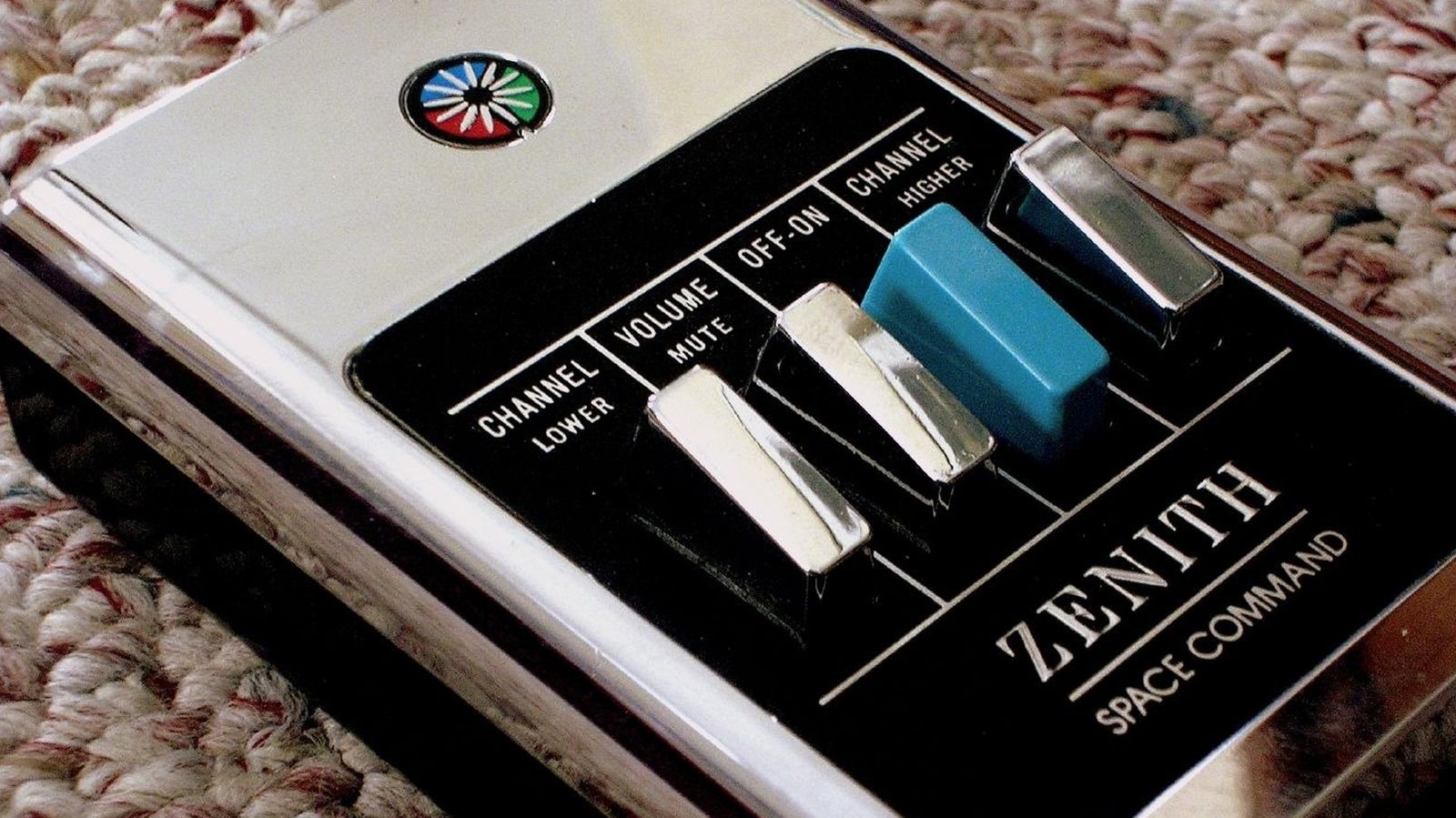
Zenith Electronics Corporation, a significant player in the television industry, developed the first functional wireless remote control known as the Space Command. Created by engineer Robert Adler in 1956, the device operated without batteries or electronics, relying instead on mechanical principles. When a button was pressed, a tiny hammer struck one of four aluminum rods of varying lengths. Each rod produced a distinct high-frequency sound that the television converted into commands for different functions, such as “channel up,” “channel down,” “sound on/off,” and “power on/off.”
The unique clicking sound made by the Space Command led to its colloquial nickname, the “clicker,” which became synonymous with remote controls for decades. Despite its innovative design, the original remote was costly, adding approximately 30% to the price of the television set, as it required six additional vacuum tubes in the receiver to interpret the sounds. Nonetheless, the technology gained traction and set the standard for future remote controls until the advent of solid-state circuitry in the early 1960s.
The Journey from Wired to Wireless
While the Space Command marked a pivotal moment in remote control history, it was not the first device to allow viewers to change channels. That distinction belongs to The Lazy Bones, a wired remote developed by Zenith in 1950. This device was designed with functionality in mind, allowing users to switch channels and adjust volume without physically interacting with the television. However, the wired connection quickly became a nuisance, posing a tripping hazard.
Five years later, in 1955, the first wireless remote, the Flash-Matic, was introduced by engineer Eugene Polley. This remote resembled a handheld flashlight and controlled the television by directing a focused light beam at photocells located at the corners of the TV. Although innovative, this system suffered from significant drawbacks. Ambient light could inadvertently trigger the photocells, leading to unintentional channel changes or volume adjustments.
The Flash-Matic was initially priced at around $100 (equivalent to nearly $1,200 today), while the accompanying television set retailed for $400 (approximately $4,800 today). The Flash-Matic had a brief production run, with an estimated 30,000 units made, due in part to its susceptibility to malfunction in bright environments.
The Rise of Infrared Technology
The introduction of solid-state circuitry in the early 1980s paved the way for the universal adoption of infrared (IR) remote controls. Unlike earlier models, IR remotes utilized a low-frequency light beam that is invisible to the human eye, transmitting commands to the television without interference from ambient light. This technology not only improved functionality but also enabled the production of more compact and affordable remote controls.
Over time, infrared remotes became a staple in households worldwide, significantly enhancing the viewing experience. The evolution of remote control technology has continued, with advancements leading to smart remotes that integrate with various devices and platforms, providing users with unprecedented control over their entertainment systems.
The remarkable journey from the early wired remotes to today’s sophisticated wireless technology highlights the continuous innovation within the television industry. Each advancement, from the mechanical workings of the Space Command to the sleek functionality of modern IR remotes, reflects a commitment to improving user experience and convenience. This evolution not only transformed how audiences engage with television but also set the stage for future developments in home entertainment technology.