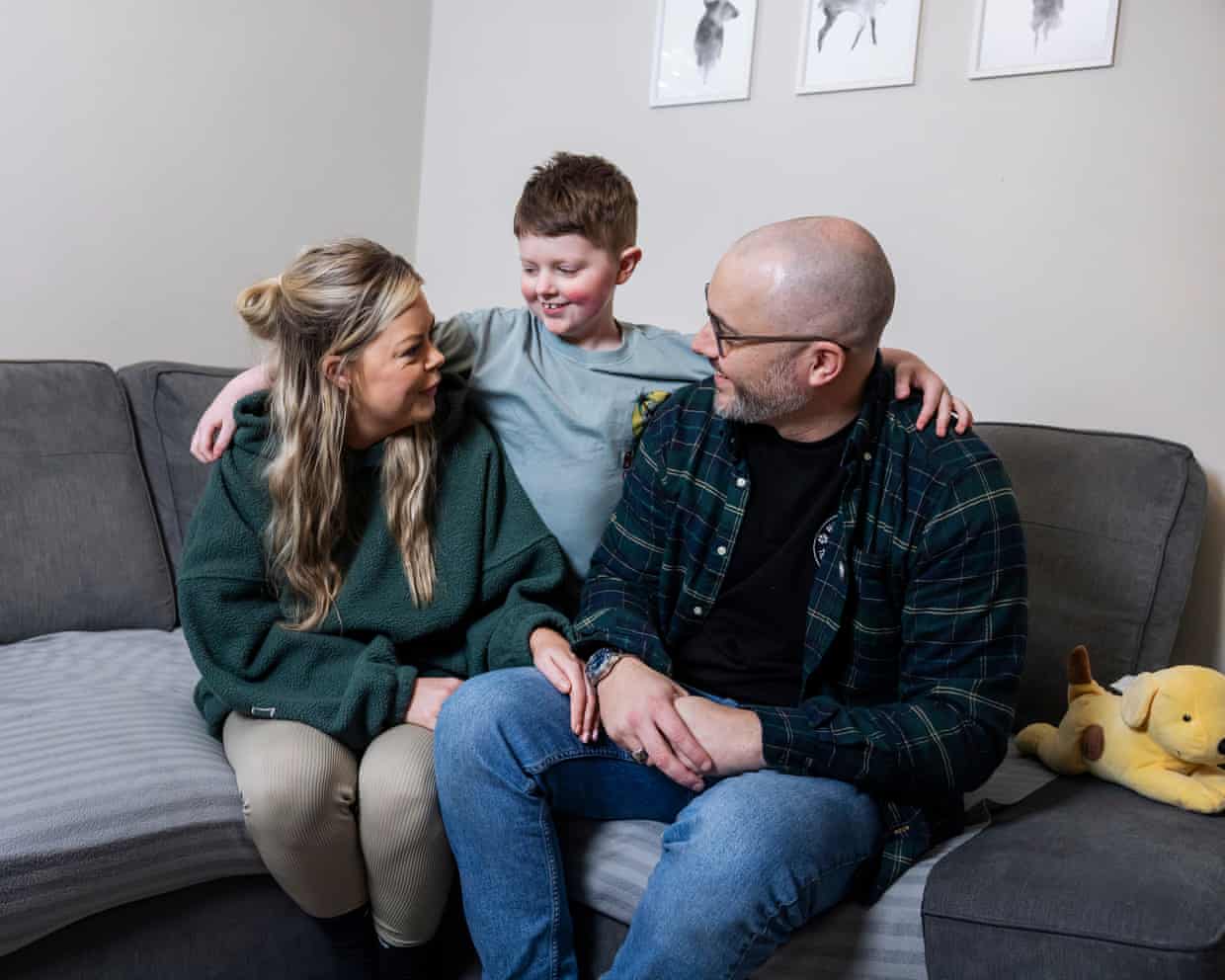
Families in Corby, Northamptonshire, are urgently seeking answers regarding a potential link between childhood cancers and historical toxic waste sites in their community. The inquiry is led by parents like Alison Gaffney and Andy Hinde, whose 17-month-old son, Fraser, was diagnosed with a rare type of leukaemia in 2018. Following two years of extensive treatment, including chemotherapy and a stem cell transplant, Fraser has since made a remarkable recovery.
However, Gaffney’s relief is tempered by unanswered questions surrounding her son’s illness. During Fraser’s treatment, a consultant’s remark that “it keeps us up at night wondering how Fraser got his cancer” lingered in her mind. Gaffney recalls the history of contaminated waste disposal in Corby, particularly following the closure of Europe’s largest steelworks in 1979, which has been linked to health issues within the community. A civil case in 2009 connected the council’s negligent handling of toxic waste to birth defects in local children during the 1980s and 1990s.
As Gaffney began to connect with other families facing similar challenges, she discovered many shared her concerns. “Everybody in this town knows somebody who’s got a child with cancer. That’s not normal,” she said. Together, they represent approximately 130 families with childhood cancer cases dating back to 1988.
The group is advocating for an investigation into any potential links between childhood cancers in Corby and the decommissioning of the steel plant. Public health officials are expected to release an analysis later this month to determine if the town, with a population of 70,000, has experienced an unusually high number of childhood cancer cases.
Gaffney’s campaign gained traction after the council announced it would assess land for contamination and investigate historical waste disposal practices. She expressed optimism about this development, stating, “We want to protect future people so they do not have to endure the pain that we’ve been through.”
The civil judgment from 2009 acknowledged the transportation of millions of tonnes of contaminated materials from the steel plant to Deene Quarry and identified concerns about dust produced during the reclamation process. However, Gaffney suspects that waste was not only deposited at the quarry but also in other areas of Corby.
During a recent meeting, North Northamptonshire Council staff admitted they lack records identifying the locations of potentially contaminated sites. In response to community concerns, the council is conducting a thorough review of historical records to investigate further. “We have no documentation, we have nothing on it,” council representatives stated.
This transparency was noted by Gaffney, who expressed pride in the council’s acknowledgment of their responsibility to the community. The announcement has also been welcomed by Tonia Shalgosky, a primary school pastoral lead whose nine-year-old daughter, Bella, was diagnosed with blood cancer earlier this year. “It’s in our interest for the council to share that information.”
The urgency of the matter is underscored by the experiences of other families. Meg Lyons, whose sister Eve passed away from a rare bone cancer in 2017, emphasized the need for transparency from local authorities. “This has been going on for far too long; it is negligence toward the people of Corby.”
Lyons’ family was among those affected by the waste removal processes linked to the steelworks. Her cousin, Maggie Mahon, experienced complications after her baby was born with clubfoot, a case included in the 2009 claim against the Corby council.
Gaffney’s campaign has also attracted whistleblowers who were involved in waste disposal. One individual, who is Gaffney’s father, described how he and others were tasked with dumping waste without proper licenses. “We were driving these big lorries through the town, just dumping it,” he recalled.
Legal representation for the families has been secured by Des Collins, who was involved in the earlier civil claim. He asserts that a statutory public inquiry is necessary to uncover the full extent of the situation. “Environmental testing is highly complex, and only a statutory inquiry can reassure the public and set out lessons to be learned,” Collins stated.
In a recent statement, Martin Griffiths, leader of North Northamptonshire Council, acknowledged the importance of collaboration with families impacted by these issues. The council is committed to establishing a working group that will include Gaffney to address public health and contamination concerns.
Gaffney remains hopeful that testing will soon commence in Corby. “Every family that comes through, I’m listening to their stories, and it’s so hard. It gives us that further fight,” she said. “We’ve got to find answers for these children.”