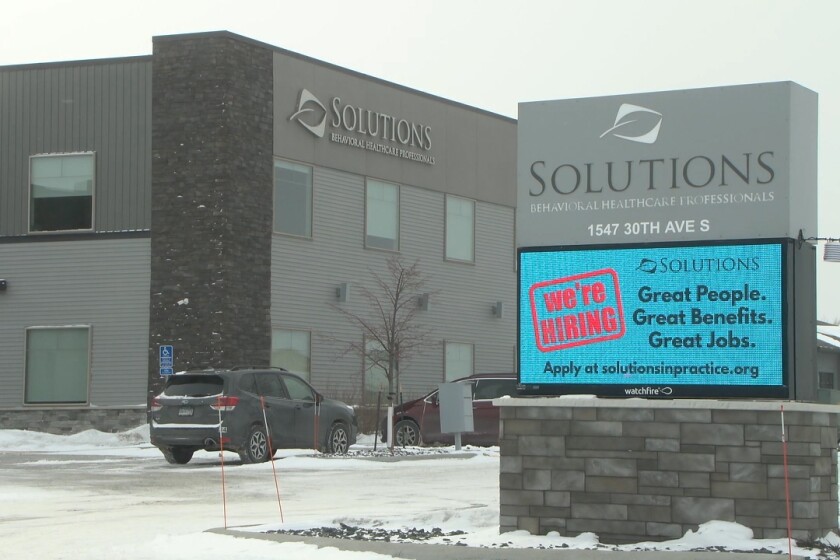
A nonprofit organization based in the Red River Valley is set to reduce services for children facing severe behavioral and mental health challenges due to changes in federal funding. Starting January 1, 2026, the North Dakota Department of Health and Human Services will impose a cap of 42 service hours annually for clients in the program, significantly impacting children like nine-year-old Asher Link, who has multiple diagnoses including PTSD, ADHD, dyslexia, and autism.
Asher’s mother, Gabbie Link, has witnessed her son’s struggles in various environments, particularly at school. She described incidents where he exhibited extreme behaviors, such as damaging classrooms and physically attacking staff members attempting to intervene. “His behaviors looked like completely trashing classrooms, attacking staff members in the school,” Link explained. “It was to the point of causing them to bleed.”
Fortunately, Asher has benefited from the support of Solutions, a Red River Valley nonprofit that has enabled him to attend school for half days. Over the past ten months, Link has noted a significant change in her son. “There’s a night and day difference, but he still needs a lot more hours and a lot more support,” she stated.
The program that supports Asher is designed to help children manage their violent behaviors and prevent escalation. Joel Bakken, executive director of Solutions, expressed concern regarding the impending limitations on service hours. He emphasized that children at risk for hospitalization typically require more than the proposed annual cap. “It would be difficult at best to pull off only needing 42 hours for that year,” Bakken remarked.
The service cap is part of a broader initiative aimed at standardizing billing and service limits for programs covered by Medicaid across North Dakota. Bakken argued that without adequate support, children like Asher face the risk of being placed in mental health facilities or even incarcerated. “Sadly, this population group is growing, and we hope we can continue to address that area,” he added.
Gabbie Link expressed her desire for Asher to lead as “normal” a life as possible. She voiced concerns that limiting his ability to interact with peers could severely impact his future. “Removing the ability to learn how to commingle with everyone else will drastically affect his future and the fact that he’s not going to learn how to be part of society,” she said.
Solutions has successfully passed several state audits in 2025 and attempted to extend the program through service agreements. However, these requests were denied due to insufficient documentation. The organization continues to advocate for the needs of its clients amid these challenges.
Efforts to reach the North Dakota Department of Health and Human Services for comments on this situation have not yet yielded a response.