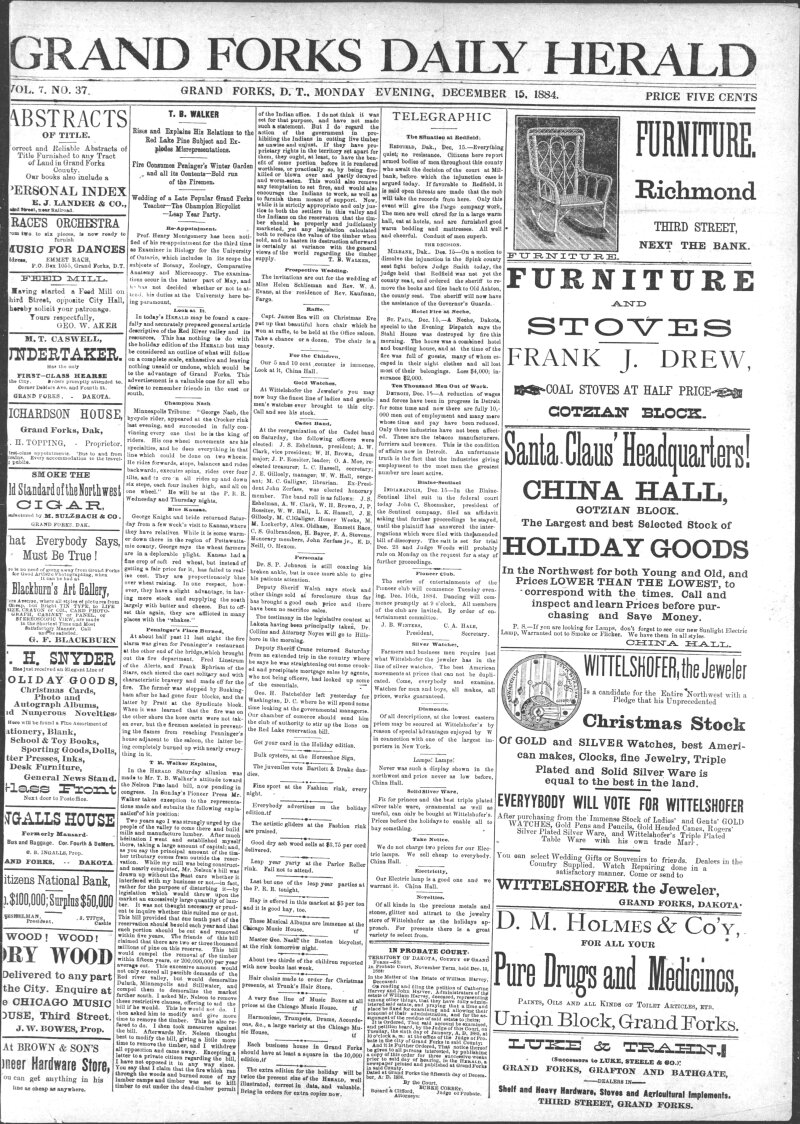
On December 15, 1884, the Grand Forks Herald reported on the rapid development of Grand Forks, a city in the Dakota Territory with a burgeoning population of approximately 5,000. The article highlighted the area’s emergence as a significant manufacturing center, driven by abundant local timber and new railway connections. With a projected investment of $250,000, a state-of-the-art Roller Mill was set to enhance flour production, marking a pivotal moment for the local economy.
The Roller Mill, spearheaded by W. H. Merritt and the Item Company, was designed to process 2,000 barrels of flour per day. This facility was expected to operate year-round, reflecting the city’s commitment to establishing itself as a manufacturing powerhouse. Grand Forks boasted a variety of other industrial capabilities, including brick production from local clay and a thriving steam brewery catering to regional barley farmers.
Educational Developments and Community Infrastructure
The article also underscored the establishment of the University of North Dakota, which was under construction at the time. The university’s main building was set to be completed in the spring of the following year, featuring a prominent location facing the Red River. Dr. W. T. Montgomery was appointed as the university’s first president, with a distinguished faculty to support its mission. This initiative not only aimed to enhance local education but also to position Grand Forks as an educational hub comparable to other major institutions in the state.
Public schools in Grand Forks were characterized as exceptional, providing quality education from September to June, and were regarded as among the finest in the region. The community’s commitment to education was further emphasized by the availability of numerous churches representing various denominations, fostering a rich cultural and moral landscape.
The local government operated under favorable homestead laws, which attracted new residents by promoting low taxes and affordable land prices. The article noted that land in the Grand Forks area was not only fertile but also accessible, with an emphasis on the promise of future land value increases as transportation infrastructure improved.
Real Estate Opportunities and Economic Potential
A significant aspect of the promotion was the appeal to “willing workers” seeking affordable housing and job opportunities. While all government lands in the immediate vicinity were reportedly claimed, prospects for purchasing valuable farmland remained, with prices ranging from $10 to $20 per acre for prime land. The expectation was that these values would likely double within two years, particularly as the Grand Forks and Red River Valley Railroad neared completion.
The article painted a picture of a vibrant community with a robust economy and a rich quality of life. The climate of the Red River Valley was described as “mild, pleasant, healthy, and delightful,” which, according to local residents, contributed to the appeal of the area. This positive portrayal aimed to entice new settlers and investors, fostering a sense of optimism about the future of Grand Forks as an emerging center of commerce and culture in the Dakota Territory.
In conclusion, the December 15, 1884 edition of the Grand Forks Herald captures a transformative period in the city’s history. With significant investments in infrastructure, education, and community development, Grand Forks was poised for growth, promising both economic opportunities and a high quality of life for its residents.