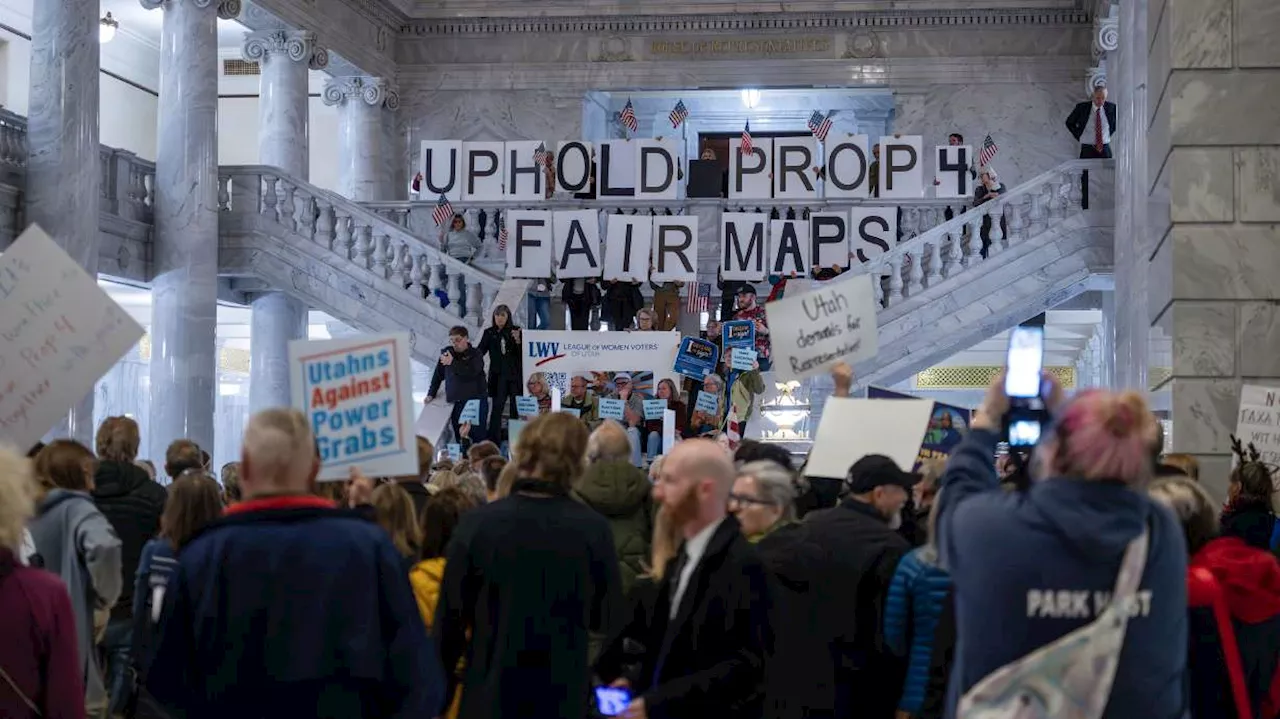
SALT LAKE CITY — The question of who should have the authority to draw congressional district maps in Utah has become a contentious issue, involving lawmakers, voters, and the judiciary. Republicans in the state Legislature assert they possess the sole constitutional power to delineate district boundaries. In contrast, the Utah Supreme Court recently ruled that lawmakers overstepped their authority when they altered Proposition 4, a 2018 ballot initiative aimed at establishing nonpartisan guidelines for redistricting.
This ruling follows a decision by 3rd District Judge Dianna Gibson, who rejected a map crafted by the Legislature, siding instead with plaintiffs who accused GOP lawmakers of gerrymandering. The alternative map proposed by these plaintiffs would create a district in northern Salt Lake County that leans Democratic, a significant shift given that all four of Utah’s congressional seats are currently held by Republicans.
In response to ongoing legal challenges, the Legislature convened a special session on March 5, 2024, to adjust the filing deadline for congressional candidates, allowing time for their appeal against Judge Gibson’s ruling to progress through the courts.
Voter Preferences and Legislative Resistance
Public sentiment appears to lean towards involving a commission in the redistricting process. Despite this, top Republicans in the Legislature have expressed reluctance to cede the drawing of political boundaries to any external entity. House Speaker Mike Schultz, R-Hooper, recently shared polling data suggesting that a majority of Utah residents prefer their elected representatives, rather than the courts, to lead the redistricting efforts.
The poll, commissioned by the conservative Sutherland Institute, indicates that only 8% of voters would favor judges selecting maps. However, the findings reveal a more complex picture. Respondents were given seven options for determining congressional district boundaries, and the last three options—county-level elected officials, state-level elected officials, and bodies elected by the people—accounted for a combined 71% of responses, while none of the alternatives exceeded 10%.
Leah Murray, director of Weber State University’s Walker Institute of Politics, noted that the question’s framing allowed for more candid responses from voters without triggering partisan biases. The survey results suggest a significant portion of the electorate desires a say in the process, even though the question did not directly reference the Legislature’s role or Proposition 4.
As the debate continues, the implications for Utah’s political landscape remain substantial. The ongoing legal battles and public opinion will likely shape the future of redistricting in the state, influencing how voters are represented in Congress.
This complex interplay between legislative authority, judicial oversight, and voter preferences underscores the challenges of navigating the redistricting process in a politically charged environment. With crucial decisions looming, the discourse surrounding who draws the maps is set to evolve further in the coming weeks and months.