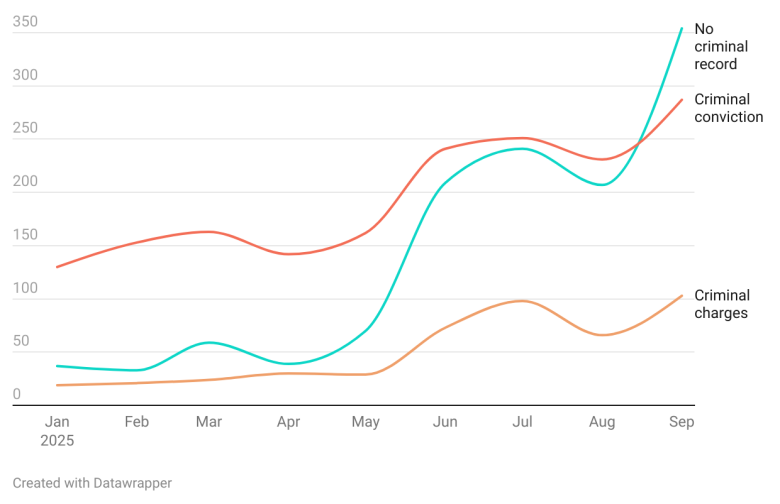
Recent data reveals a significant shift in the profile of individuals arrested by Immigration and Customs Enforcement (ICE) in Northern California. For the first time, 48 percent of those apprehended have no prior criminal record. This information, released in September, underscores a broader trend that has seen ICE arrests in the region more than triple compared to the same period last year.
An analysis by the Deportation Data Project, a research initiative at the University of California, Berkeley, indicates that in September, 39 percent of individuals arrested had a criminal conviction, while the remaining 14 percent faced pending criminal charges. This marks a sharp increase from earlier months, when the majority of arrests were focused on those with criminal backgrounds.
The recent statistics come in the wake of the Trump administration’s pledge to expel what it termed the “worst of the worst.” Yet, the data suggests that the crackdown has increasingly targeted individuals who have not committed any crimes. President Trump has also advocated for a permanent pause on immigration from what he referred to as “third-world countries.”
Nationally, approximately 74 percent of individuals held in ICE detention centers lack a criminal history, according to the Transaction Records Access Clearinghouse at Syracuse University. In October, a Mission Local report indicated a decline in arrests at San Francisco’s immigration courthouse, where individuals with pending asylum cases are required to attend routine hearings. Despite this, the overall number of ICE arrests in Northern California has surged, with figures tripling between January 20 and October 15, 2025, compared to the same timeframe the previous year.
The San Francisco Chronicle also reported a 78 percent increase in deportations across California compared to 2024. However, this figure may underrepresent the actual numbers, as about 11 percent of the data from ICE for 2025 did not specify the state of the arrest, leading to exclusions in the analysis for Northern California.
Data indicates a troubling rise in detentions at the short-term facility located at 630 Sansome Street. In September, the facility recorded 246 new detention stays, reflecting a 67 percent increase from the previous month. Typically, individuals are held there for only a few hours before being transferred to long-term facilities. Yet, prior investigations have uncovered instances where at least 38 individuals were detained for longer than the recommended 12 hours.
As the situation evolves, the implications of these arrest patterns raise significant questions about immigration enforcement priorities. The increasing number of individuals arrested without a criminal history suggests a shift in focus that may impact communities across Northern California and beyond.