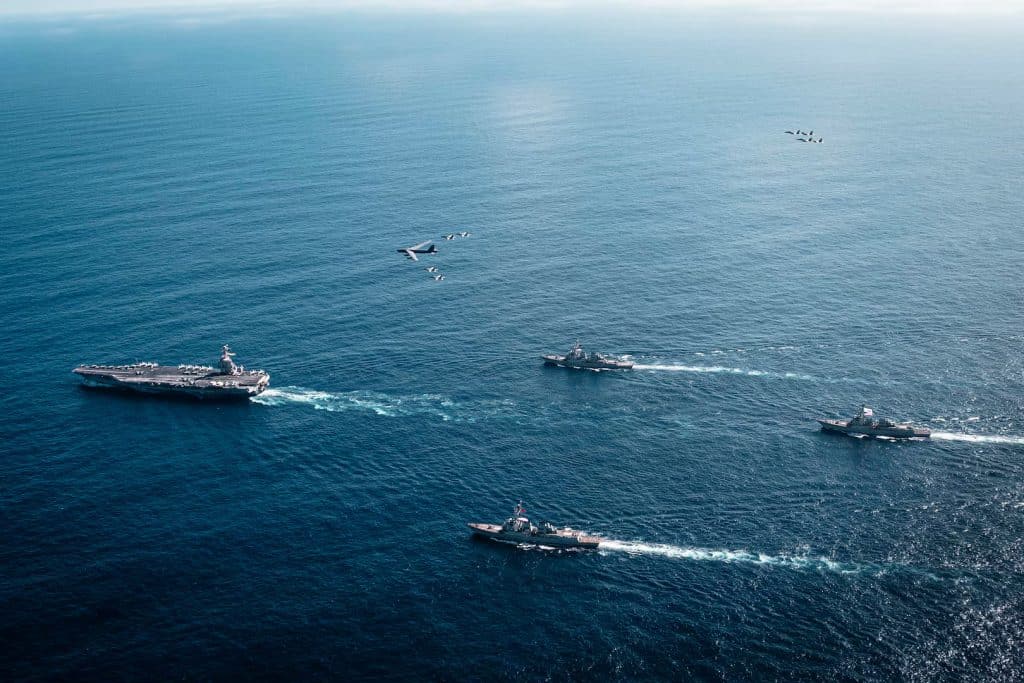
Defense Secretary Pete Hegseth has defended recent U.S. military strikes on boats linked to drug cartels, asserting that President Donald Trump has the authority to take military action “as he sees fit.” These comments were made during a national security forum at the Ronald Reagan Presidential Library and come amid growing scrutiny regarding the legality of such strikes under international law. Hegseth drew a parallel between Trump and Reagan, claiming the current president is the “true and rightful heir” to the former leader’s legacy.
As the Trump administration grapples with these controversies, the nation remembers the historical significance of events like the attack on Pearl Harbor. Only twelve survivors of the 1941 attack remain, all centenarians. This year, none will attend the annual remembrance ceremony in Hawaii, marking a poignant transition as their firsthand accounts fade from public memory. The attack resulted in the deaths of more than 2,300 U.S. troops and marked the United States’ entry into World War II.
In West Africa, troubling reports emerge from Mali where eyewitnesses have described severe atrocities, including beheadings and sexual assaults, committed by the newly formed Africa Corps. This military unit, under direct Russian command, has replaced the Wagner mercenary group in its operations with the Malian army against extremist groups. Legal analysts suggest that because the Africa Corps operates under Russian government supervision, Moscow bears direct responsibility for these human rights violations.
In another tragic incident, a fire at a nightclub in Goa, India, has claimed the lives of at least 25 individuals, including several tourists. The fire, which erupted shortly after midnight due to a gas cylinder explosion, primarily affected kitchen staff. Local officials reported that all bodies have been recovered, and the blaze has since been extinguished.
Tensions are mounting in the Asia-Pacific region as both Japan and Australia have urged calm following an incident in which Chinese military aircraft locked radar onto Japanese fighter jets. This occurred near Okinawa and has sparked diplomatic protests. Japan’s Defense Minister Shinjiro Koizumi deemed the act “extremely regrettable,” emphasizing the importance of safe interactions in the region.
In Ukraine, a significant missile and drone attack by Russia has caused widespread damage to energy infrastructure, with at least eight individuals reported injured. The assault prompted air raid alerts across several areas, with Ukrainian forces successfully intercepting a number of the incoming threats. President Volodymyr Zelenskyy continues to engage in discussions about potential peace talks with U.S. officials as the conflict nears its fourth year.
Meanwhile, Qatar’s Prime Minister, Sheikh Mohammed bin Abdulrahman Al Thani, has indicated that the ceasefire in Gaza is at a “critical moment.” As the initial phase of the peace agreement comes to an end, international mediators are focusing on establishing a second phase to ensure stability, which would involve a complete Israeli withdrawal from Gaza and the introduction of an international security force.
Lastly, the U.S. Supreme Court is set to hear a case that could expand presidential powers, a move that underscores a trend initiated during Trump’s presidency. Chief Justice John Roberts leads the conservative majority, which may reconsider a 90-year-old decision that restricts the president’s ability to dismiss heads of independent agencies.
As these global events unfold, the implications of military actions, humanitarian crises, and diplomatic tensions continue to reverberate, shaping the landscape of international relations and domestic policies.