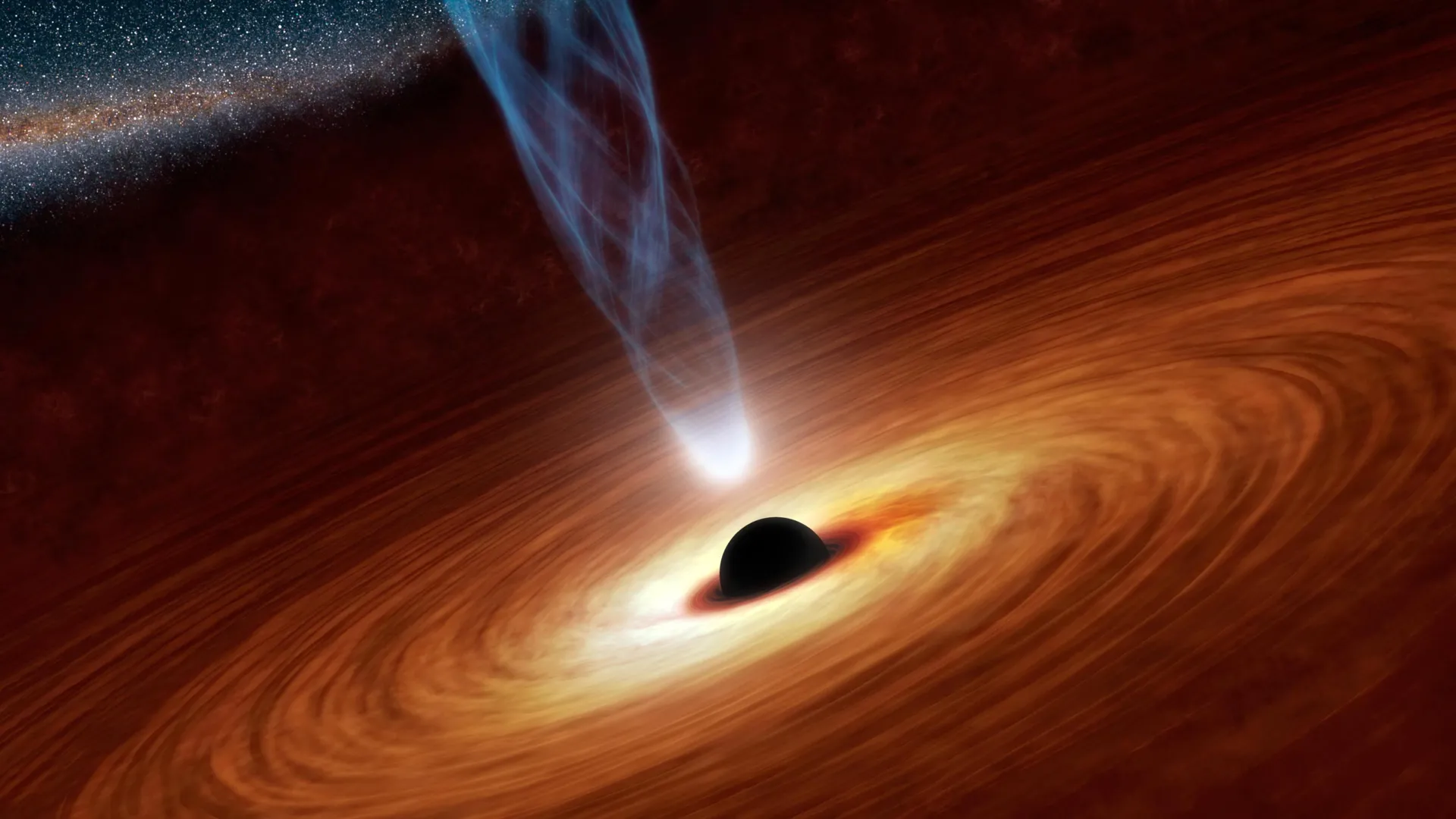
Astronomers have identified a quasar with a supermassive black hole growing at an extraordinary rate, challenging existing theoretical models of black hole formation. This discovery, made by an international team led by researchers from Waseda University and Tohoku University, suggests the black hole is consuming matter at approximately 13 times the Eddington limit, a rate far exceeding what was previously thought possible.
Using data from the Subaru Telescope, the team observed a quasar that exhibits a rare combination of characteristics. The black hole at its center is not only drawing in matter at a remarkable pace but is simultaneously emitting intense X-rays and producing a powerful radio jet. This unusual behavior contradicts many current models that predict these features should not coexist, making this quasar a significant find for researchers.
Insights into Black Hole Growth
Supermassive black holes, typically found at the centers of most galaxies, can have masses ranging from millions to billions of times that of the Sun. They grow by accreting surrounding gas, which forms a rotating accretion disk. As this infalling material spirals closer, it generates a highly energized plasma region known as a corona, a major source of X-ray emissions. When these black holes are particularly luminous and actively feeding, they are termed quasars.
A key question in astrophysics has been how some of these massive black holes managed to grow so quickly in the early universe. One proposed explanation involves a process called super-Eddington accretion, where under certain extreme conditions, black holes can exceed the theoretical limit on their growth for brief periods.
To explore this phenomenon, the researchers utilized the Subaru Telescope’s near-infrared spectrograph. By analyzing the movement of gas near the quasar and studying the Mg II (2800 Å) emission line, they estimated the black hole’s mass and determined it existed around 12 billion years ago.
A Quasar That Defies Conventional Theories
The findings reveal that during super-Eddington growth, many theoretical models suggest a weakening of X-ray emissions and suppression of jet activity due to changes in the accretion flow. Contrary to these predictions, the quasar remains bright in X-rays and exhibits strong radio emissions simultaneously.
This dual activity suggests that the black hole may be in a transitional phase, potentially following a sudden influx of gas that drives it into a super-Eddington state. For a limited time, both the X-ray-emitting corona and the radio jet remain highly active before the system settles into a typical growth mode.
Lead author Sakiko Obuchi from Waseda University expressed that this discovery could deepen understanding of how supermassive black holes formed rapidly in the universe’s early stages. The researchers aim to further investigate the origins of the exceptionally strong X-ray and radio emissions and whether similar quasars have been overlooked in previous surveys.
The quasar’s powerful radio jet indicates it carries enough energy to influence its surroundings, potentially heating or disrupting gas within its host galaxy. This interaction could impact star formation and shape the evolution of both galaxies and their central black holes. The relationship between super-Eddington growth and jet-driven feedback remains poorly understood, making this quasar a vital reference point for future studies.
The research findings were published on January 21, 2026, in the Astrophysical Journal, under the title “Discovery of an X-ray Luminous Radio-Loud Quasar at z = 3.4: A Possible Transitional Super-Eddington Phase.” This work received support from several grants, including the Grants-in-Aid for Scientific Research and the JST FOREST Program.
The Subaru Telescope, which facilitated this groundbreaking research, is operated by the National Astronomical Observatory of Japan and the National Institutes of Natural Sciences, with backing from the MEXT Project to Promote Large Scientific Frontiers. The team acknowledges the cultural significance of Maunakea in Hawai’i, where these observations were conducted.