New research indicates that the dynamics surrounding supermassive black holes, particularly the relationship between ultraviolet and X-ray emissions in quasars, may be evolving over billions of years. This significant finding, published on December 27, 2025, in the Monthly Notices of the Royal Astronomical Society, challenges longstanding assumptions about the consistency of black hole environments throughout cosmic history.
An international team of astronomers, led by the National Observatory of Athens, discovered evidence suggesting that the material surrounding these black holes has not remained static. Rather, it appears to have undergone substantial changes as the universe aged, potentially shifting our understanding of black hole behavior and growth.
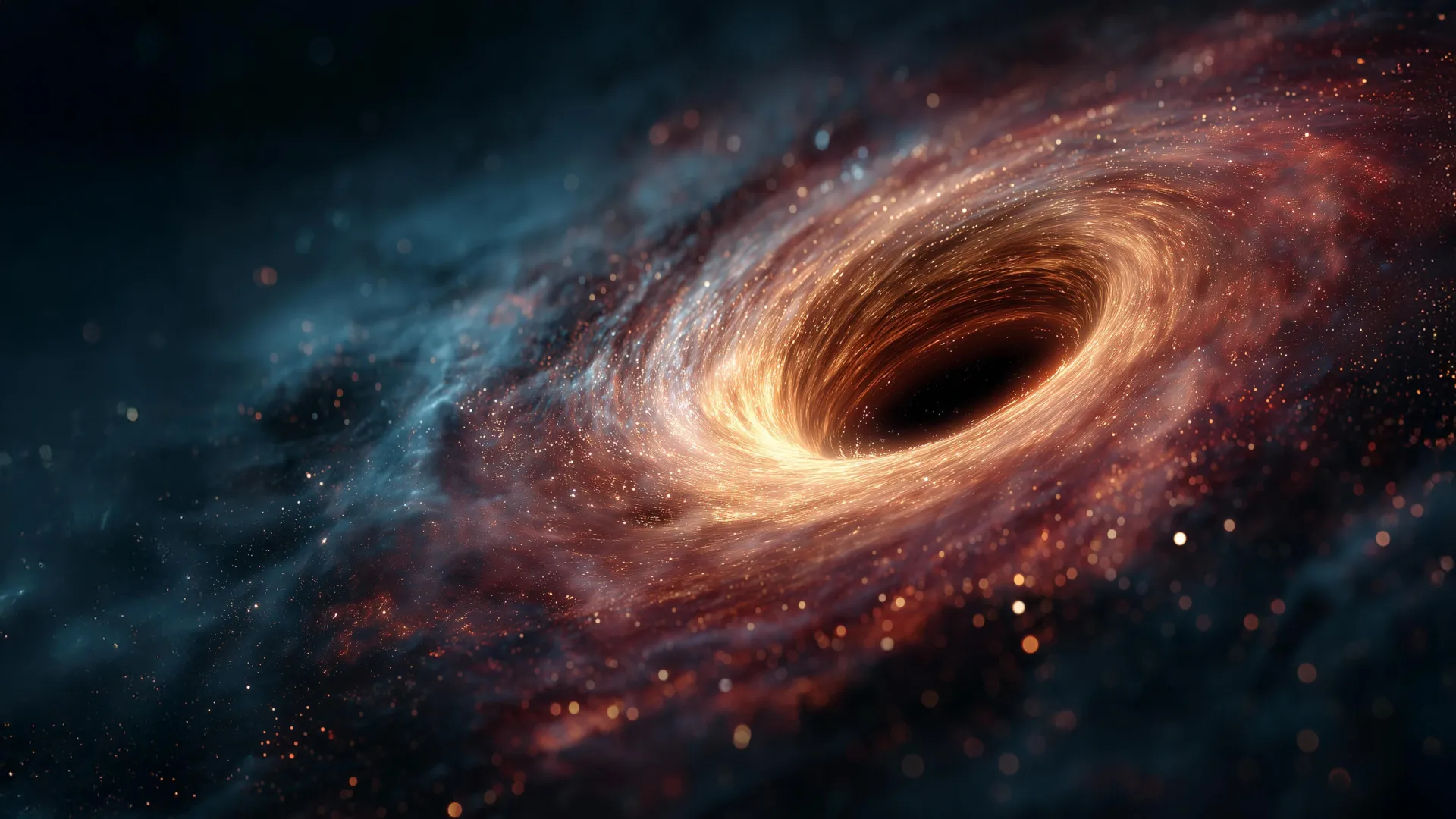
Quasars, first identified in the 1960s, are among the most luminous objects in the universe. Powered by supermassive black holes, they shine with a brightness that can exceed that of entire galaxies, which typically contain around 100 billion stars. As matter spirals into a black hole, it forms a rotating disk that generates immense heat, allowing it to emit energies that can be 100 to 1,000 times brighter than typical galaxies.
The process begins with the emission of ultraviolet light from the accretion disk surrounding a black hole. This light plays a crucial role in producing the more energetic X-rays that quasars emit. As ultraviolet rays travel outward, they encounter highly energized particles in a region known as the “corona.” This interaction amplifies the energy of the ultraviolet light, converting it into intense X-ray radiation detectable by space observatories.
Traditionally, astronomers have understood that the relationship between ultraviolet and X-ray emissions in quasars is consistent, with brighter ultraviolet light correlating with stronger X-ray output. However, this new study suggests that this connection varies over cosmic time. Researchers found that when the universe was significantly younger—approximately 6.5 billion years ago—the relationship between these two types of light was markedly different from what is observed today in nearby quasars.
Dr. Antonis Georgakakis, one of the authors of the study, remarked, “Confirming a non-universal X-ray-to-ultraviolet relation with cosmic time is quite surprising and challenges our understanding of how supermassive black holes grow and radiate.” The researchers employed various analytical methods to validate their findings, which appeared resilient across different tests.
To arrive at these conclusions, the research team utilized data from the eROSITA X-ray telescope and archival information from the European Space Agency’s XMM-Newton X-ray observatory. This combination enabled an extensive analysis of X-ray and ultraviolet emissions from a large sample of quasars. The broad and consistent sky coverage provided by eROSITA was particularly significant, allowing for an unprecedented examination of quasar populations.
The implications of these findings extend into cosmology, as the assumption of a universal X-ray and ultraviolet relationship underpins certain methodologies that use quasars as “standard candles” for mapping the universe’s shape and researching dark matter and dark energy. With the new results suggesting that these environments may not be unchanging, scientists are advised to exercise caution in their approaches.
Maria Chira, a postdoctoral researcher at the National Observatory of Athens and leader of the study, noted, “The key advance here is methodological. The eROSITA survey is vast but relatively shallow—many quasars are detected with only a few X-ray photons. By combining these data in a robust Bayesian statistical framework, we could uncover subtle trends that would otherwise remain hidden.”
Looking forward, upcoming all-sky scans from eROSITA are expected to allow astronomers to observe even fainter and more distant quasars. By integrating these future observations with next-generation X-ray and multiwavelength surveys, researchers aim to determine whether the observed changes reflect genuine physical evolution or merely variations in data collection methods.
These efforts promise to provide deeper insights into the mechanics of supermassive black holes and how their interaction with surrounding matter has transformed over cosmic time. As our understanding of these celestial giants evolves, so too may our comprehension of the universe itself.