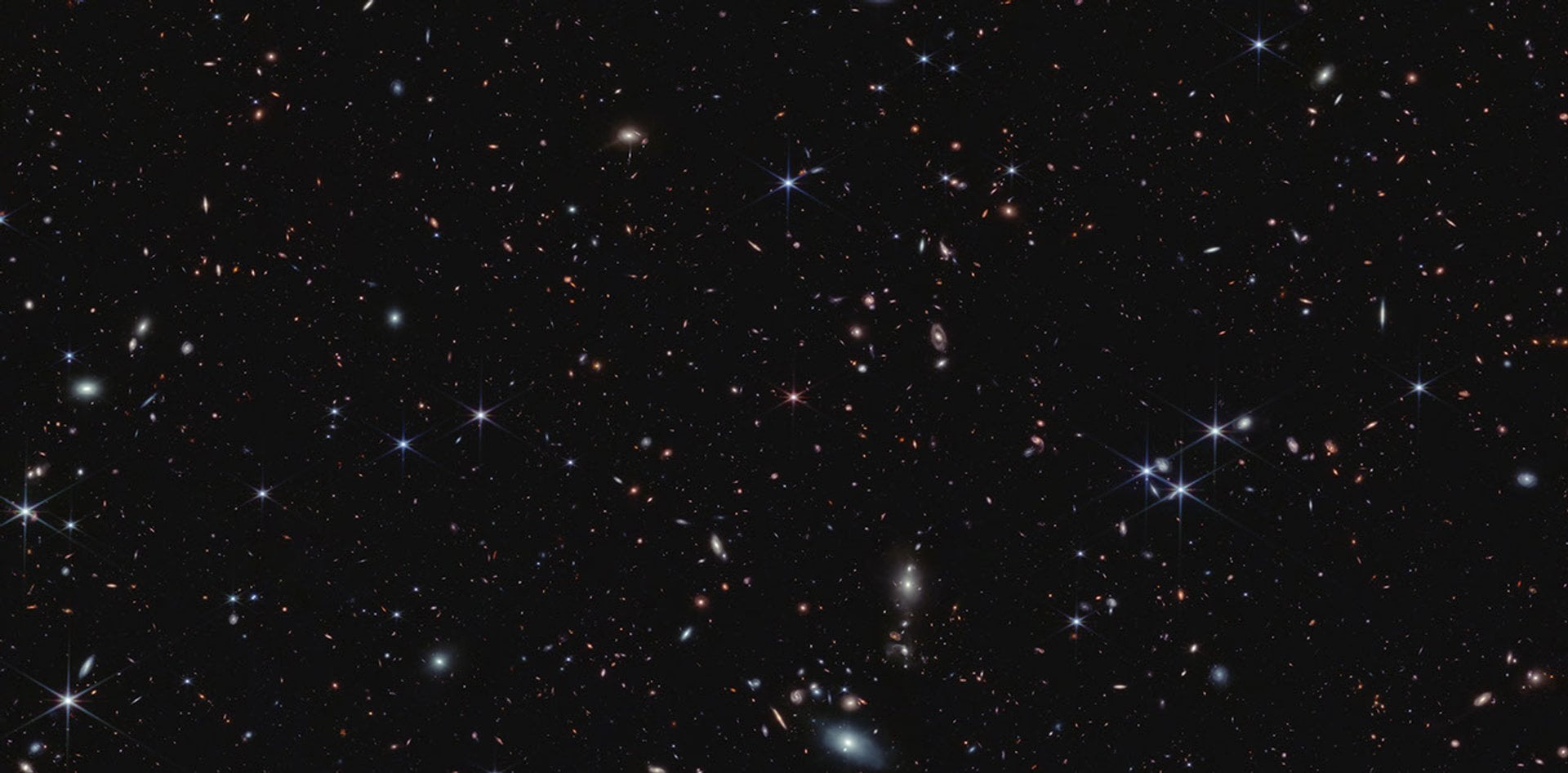
Astronomers have uncovered compelling evidence suggesting the existence of massive stars, dubbed “monster stars,” in the early universe. Utilizing the advanced capabilities of the James Webb Space Telescope (JWST), an international research team led by Devesh Nandal from the University of Virginia and the Institute for Theory and Computation (ITC) at the Harvard & Smithsonian Center for Astrophysics has shed light on a long-standing mystery surrounding the formation of supermassive black holes (SMBHs).
For over two decades, astronomers have struggled to explain how these gravitational giants, which can weigh millions to billions of solar masses, emerged less than a billion years after the Big Bang. Traditional models suggested that massive black holes could not have formed quickly enough through the standard processes of black hole formation or mergers. Recent observations, however, provide support for an alternative hypothesis: that the “seeds” of SMBHs formed directly from collapsing clouds of cosmic gas, known as direct collapse black holes (DCBHs).
The research team focused on a galaxy named GS 3073, which was initially identified in 2022 by Muhammad A. Latif and Daniel Whalen along with their colleagues from the Institute for Astronomy (IfA) at the University of Edinburgh, the University of Exeter, and the Herzberg Astronomy and Astrophysics Research Centre. During their study, they observed an extreme nitrogen-to-oxygen ratio of 0.46 in the galaxy that could not be explained by any known types of stars or stellar explosions.
Unveiling the Origins of “Monster Stars”
This anomaly led the researchers to propose that the first stars in the universe, known as Population III stars, formed from turbulent flows of cold gas shortly after the Big Bang. They suggested that GS 3073 harbors an actively feeding black hole at its center, likely a remnant of one of these massive stars. Nandal commented in a press release from the University of Portsmouth, stating, “To test this theory, we modeled how stars of 1,000 to 10,000 solar masses would evolve and what chemicals they would produce.”
The modeling identified a specific mechanism responsible for the observed nitrogen-to-oxygen ratio. It involves monster stars fusing helium in their cores to create carbon, which then interacts with hydrogen in the outer layers. This process eventually leads to the production of nitrogen, which is disseminated into space. The research indicates that these massive stars do not end their life cycles with supernova explosions but instead collapse directly into massive black holes, potentially serving as the building blocks for the SMBHs observed today.
Implications for Cosmology
The implications of this discovery extend beyond the existence of monster stars. If confirmed, these findings may help explain two significant mysteries highlighted in prior observations from the JWST. They also provide fresh insights into the universe’s state between 380,000 and 1 billion years after the Big Bang, a period known as the “Cosmic Dark Ages.”
Until the advent of the JWST, this epoch remained largely inaccessible to astronomers due to the faintness of light from that era, necessitating advanced infrared optics. The research team anticipates that more galaxies exhibiting similar nitrogen excesses will emerge in future surveys, enabling further exploration of the possible existence of monster stars.
This groundbreaking work, which has been published in the journal Nature, not only enhances our understanding of the formation and evolution of the early universe but also opens new avenues for research in astrophysics.