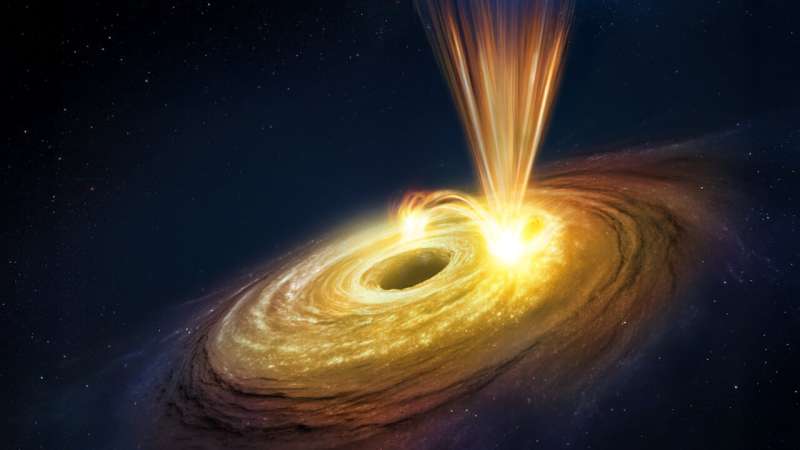
An international team of astronomers has made a groundbreaking observation of a supermassive black hole, NGC 3783, ejecting matter at speeds reaching up to 20% of the speed of light. This remarkable event, captured over a ten-day period primarily using the XRISM space telescope, marks a significant leap in understanding black hole dynamics and magnetic phenomena.
During this observation, researchers noted a sudden outburst of matter, which is typically propelled by intense radiation. However, in this case, the likely cause appears to be a rapid change in the black hole’s magnetic field, akin to the solar flares observed on the sun. This discovery is particularly notable as it is the first clear evidence of a high-speed ejection occurring simultaneously with an X-ray burst.
Details of the Observation
The ten-day observation period represents the longest continuous monitoring that XRISM has conducted to date. Throughout this time, scientists recorded fluctuations in X-ray brightness, especially within the softer X-ray spectrum. Among these variations was a significant outburst lasting three days, which, while not unprecedented for supermassive black holes, was unique due to the concurrent ejection of gas from the black hole’s accretion disk.
This gas was expelled at astonishing velocities, reaching up to 60,000 kilometers per second. The ejection originated from a region approximately fifty times the size of the black hole itself, where gravitational and magnetic forces interact in extreme conditions. The team attributes this high-speed ejection to a phenomenon known as magnetic reconnection, which involves a sudden realignment of magnetic fields and releases vast amounts of energy.
Liyi Gu, the lead author of the study published in Astronomy & Astrophysics, emphasized the significance of this discovery, stating, “This is a unique opportunity to study the launch mechanism of ultrafast outflows. The data suggest that the acceleration of the outflow is driven by magnetic forces, similar to coronal mass ejections from the sun.”
Implications for Astrophysics
Coronal mass ejections, which occur when large blobs of hot plasma are hurled into space from the sun, are dwarfed by the magnitude of these black hole eruptions. The findings challenge existing theories that suggest black holes primarily expel matter through intense radiation or heat. Instead, the researchers propose a model where sudden bursts of magnetic energy are the driving force behind these extraordinary phenomena.
This research sheds light on the dual nature of black holes, revealing that they not only consume matter but can also expel it, contributing to a process known as feedback. This feedback is essential in understanding how galaxies evolve and interact over time, influencing surrounding stars and gas, ultimately shaping the universe as we see it today.
The collaborative effort underscored the importance of international cooperation in space exploration. A fleet of seven space missions, led by XRISM, worked together to observe the same target, with support from XMM-Newton, NuSTAR, Hubble, Chandra, Swift, and NICER.
As scientists continue to analyze the data from this remarkable observation, they look forward to uncovering more about the violent and dynamic nature of supermassive black holes. This discovery not only deepens our understanding of these cosmic giants but also opens new avenues for research into the fundamental processes that govern the universe.