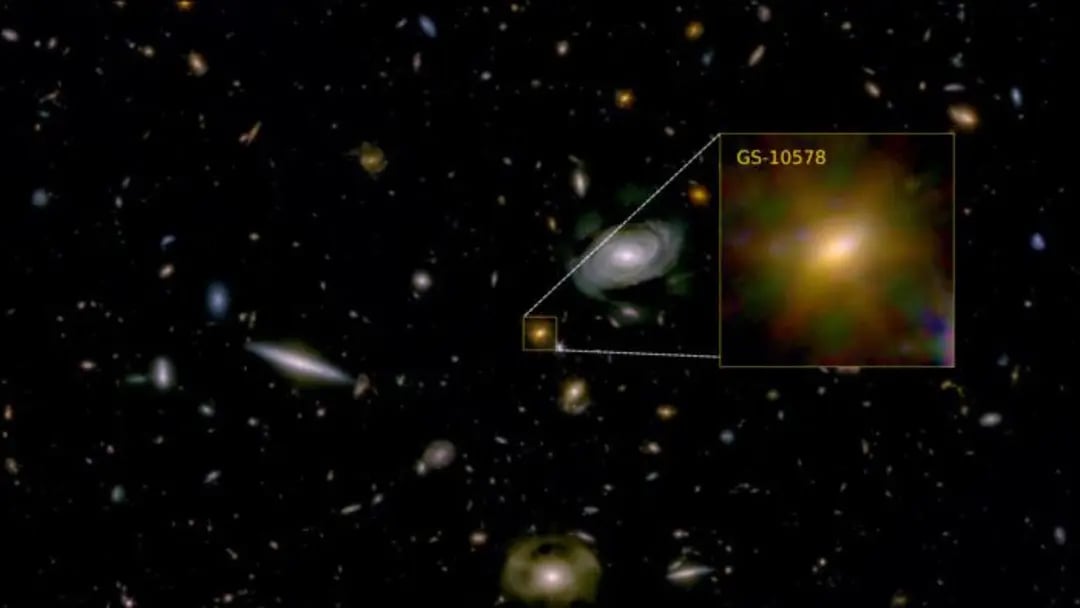
Galaxies can fade away in subtle and unexpected ways, a phenomenon highlighted by recent observations of a galaxy designated GS-10578, commonly referred to as ‘Pablo’s Galaxy’. Approximately 10.8 billion light years from Earth, this galaxy has been observed in a state of gradual decline, primarily influenced by the supermassive black hole at its centre.
Astronomers from the University of Cambridge utilized the James Webb Space Telescope and the Atacama Large Millimetre Array (ALMA) to investigate the galaxy’s unusual behaviour. Forming the majority of its stars between 12.5 and 11.5 billion years ago, Pablo’s Galaxy amassed about 200 billion solar masses in just one billion years. However, its star formation abruptly ceased, prompting researchers to explore the potential role of its central black hole.
During nearly seven hours of observation with ALMA, astronomers sought to detect carbon monoxide, a key indicator of cold hydrogen gas essential for star formation. Surprisingly, their findings indicated that the galaxy was nearly devoid of this star-forming material.
Concurrently, JWST spectroscopy revealed powerful winds emanating from the supermassive black hole, moving at speeds of 400 kilometres per second and expelling approximately 60 solar masses of gas each year. At this rate, Pablo’s Galaxy could exhaust its remaining star-forming gas within just 16 to 220 million years, a stark contrast to the billion-year timescales typically observed in similar galaxies.
Uncovering the Mechanisms of Galactic Decline
Despite the impending depletion of resources, Pablo’s Galaxy appears remarkably serene. Observations from JWST depict it rotating smoothly like a disc, lacking any signs of the violent mergers that often disrupt galactic structures. This observation rules out external catastrophic events as the cause of its decline.
The underlying issue seems to stem from a more insidious process—repeated cycles of heating. Instead of experiencing a catastrophic explosion that would tear the galaxy apart, the supermassive black hole has gradually heated or expelled incoming gas over time. Each event has inhibited fresh material from settling into the galaxy’s star-forming regions. Cut off from new supplies, Pablo’s Galaxy has been steadily consuming its existing reserves, leading to its current state of dormancy.
This discovery sheds light on a puzzling phenomenon observed in the early universe. The James Webb Space Telescope continues to identify a surprising number of massive galaxies that appear older than expected. Prior to Webb’s launch, such objects were almost entirely unknown. Now, these galaxies seem more common, suggesting that the slow starvation caused by central black holes may explain how they rapidly consumed their fuel and subsequently faded into darkness.
The implications of this research extend beyond the fate of Pablo’s Galaxy. Understanding the mechanisms by which supermassive black holes influence their host galaxies may provide crucial insights into galaxy evolution across the cosmos. As astronomers continue to study these distant celestial bodies, the nuanced interactions between black holes and galaxies reveal a complex narrative of cosmic life—one that unfolds over billions of years.
As our observational capabilities improve, the mysteries of the universe, including the fate of galaxies like Pablo’s, become increasingly accessible, allowing for deeper exploration into the life cycles of these magnificent structures.