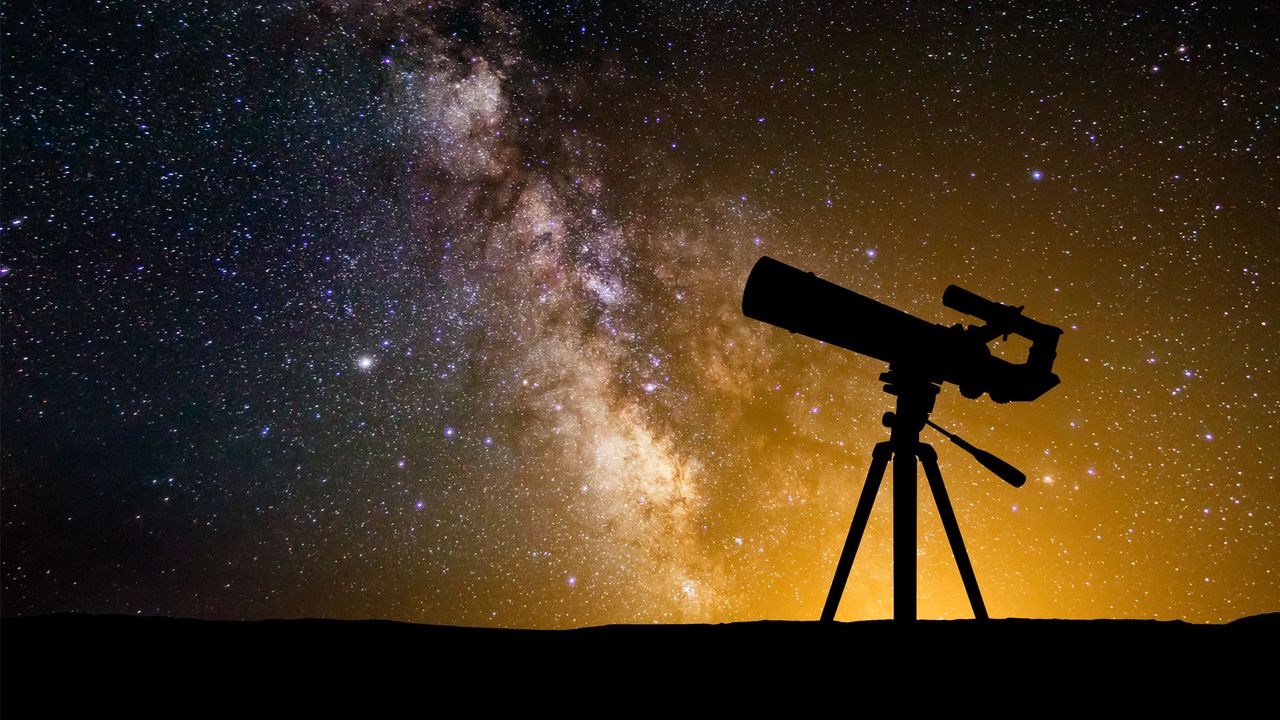
As the festive season of December 2025 approaches, new telescope owners are in for a treat. This week offers a unique opportunity to explore the cosmos, featuring a waxing crescent moon and the brilliant planet Jupiter, which is set to shine prominently in the evening sky. Enthusiasts can also look forward to the upcoming Wolf Supermoon, expected in early January 2026, making this an exciting time for both novice and experienced astronomers alike.
Getting started with a new telescope involves more than simply pointing it at the night sky. The key is to approach your first observations with patience. Begin by familiarizing yourself with the telescope’s setup. Assemble the device during daylight using the provided instructions, ensuring the tripod is level and all clamps are secure. Understanding the functionality of various knobs and levers is essential, as is aligning the finder scope with a distant object, such as a tree. This day-time preparation will help your telescope acclimatize, resulting in clearer views once night falls.
Finding the Moon
A crescent moon is an excellent first target for those new to astronomy. During the final week of December, the moon will transition from a thick crescent on Christmas Day to a first quarter phase by December 27, making it easily observable shortly after sunset. For beginners, using the low-power 25mm eyepiece is advisable to locate the moon. Once centered, focus on the terminator—the line dividing light and dark on the moon’s surface. This area reveals intriguing details such as shadowed craters and mountains. After gaining a clear image, switch to the medium-power 10mm eyepiece for a closer look.
While the full moon can be visually stunning during a moonrise, it is not the best time for detailed observations due to the brightness of the light. Instead, focus on the moon in its earlier phases for optimal viewing.
Navigating the Night Sky
The winter sky is rich with constellations and deep-sky objects. Understanding these patterns can significantly enhance your observing experience. Constellations serve as geographical markers, helping you locate various celestial objects. In late December and early January, prominent constellations such as Orion, Taurus, Auriga, and Gemini dominate the southeastern sky. Jupiter, shining brightly within this area, provides an easy reference point for new telescope users.
In the Northern Hemisphere, locating Orion’s Belt and tracing it to bright stars like Capella in Auriga and the Pleiades cluster in Taurus can guide you to interesting targets. For those observing from the Southern Hemisphere, Orion appears inverted in the northeast, accompanied by Taurus, while bright stars like Sirius and Canopus illuminate the southern sky.
Once familiar with these constellations, it becomes easier to direct your telescope towards star clusters or nebulae within them.
Observing Planets
Distinguishing between planets and stars is straightforward; planets do not twinkle and appear as larger disks. During this season, Jupiter and Saturn are the primary attractions. Jupiter, in particular, will reach opposition on January 10, 2026, when it is closest to Earth and appears its largest and brightest. You can look east in the early evening for this bright “star,” which is located near the twin stars of Gemini, Castor and Pollux.
To begin observing, center Jupiter in the finder and then switch to the 25mm eyepiece. With a clean focus, you may observe cloud bands and potentially up to four of its moons: Ganymede, Callisto, Europa, and Io. Jupiter will be visible all night during January, offering ample opportunities for observation.
Saturn, while lower and fainter than Jupiter, can also be observed early in the evening. Its iconic rings, which will be edge-on during this period, are visible even through modest telescopes. Again, start with the red dot finder and a low-power eyepiece before switching to higher magnification.
Highlight Targets in the Northern Hemisphere
The winter sky in the Northern Hemisphere boasts several noteworthy objects ideal for first-time telescope users, including:
– Orion Nebula (M42) in Orion
– Pleiades (M45) open cluster in Taurus
– Double Cluster (NGC 869 and NGC 884) in Perseus
– Beehive Cluster (M44) in Cancer
– Crab Nebula (M1) in Taurus
– Andromeda Galaxy (M31) in Andromeda
Highlight Targets in the Southern Hemisphere
For those located in the Southern Hemisphere, the same December to January period highlights several spectacular celestial bodies, including:
– Orion Nebula (M42) in Orion
– Pleiades (M45) open cluster in Taurus
– Carina Nebula (NGC 3372)
– Southern Pleiades (IC 2602)
– Large Magellanic Cloud (LMC) and Small Magellanic Cloud (SMC)
– Omega Centauri (NGC 5139)
Having successfully navigated your first observations, the next phase is to deepen your understanding of the night sky. Take your time, gradually expanding your knowledge and experience. Clear, dark nights—especially those between the last quarter moon and new moon—are ideal for exploration. With consistent observation, the seemingly infinite stars transform into a familiar map, revealing a landscape you will come to know intimately.