In a recent inquiry, a young student from Virginia, Tim, posed an interesting question about chemical reactions, leading to a detailed exploration of this fundamental aspect of science. Dr. Universe, a science communicator, provided insights into how chemical reactions occur frequently in nature and everyday life.
Understanding Chemical Reactions
A chemical reaction occurs when one or more substances, known as reactants, undergo a change to form one or more new substances, termed products. According to Mary Fennimore, a chemistry instructor at Washington State University, this process involves the rearrangement of atoms. The transformation can be represented with a simple equation, where the reactants lead to products, denoted by an arrow:
reactants ➔ products
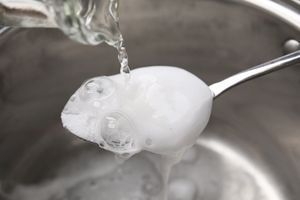
Some chemical reactions are easily visible, such as color changes or the release of gas bubbles, while others are more subtle. For instance, in baking, the combination of baking soda and vinegar creates a chemical reaction that is vital for achieving the desired texture in baked goods like depression cake—a recipe that originated during the Great Depression in the 1930s when ingredients were scarce.
The Role of Baking Soda and Vinegar
In the case of depression cake, the reaction between baking soda, whose chemical formula is NaHCO3, and vinegar, represented by C2H4O2, results in the formation of carbon dioxide gas. This gas is crucial for the cake’s rise and light texture. Fennimore explains that during baking, moisture and heat cause baking soda to react, producing carbon dioxide gas, which forms bubbles that make the cake fluffy.
The initial reaction can be expressed as follows:
NaHCO3 + C2H4O2 ➔ NaC2H3O2 + H2CO3
In this equation, the same number of atoms remains on both sides of the arrow, but they are rearranged into new compounds. The compound NaC2H3O2, which remains in the cake, contributes to its flavor and helps prevent mold. The second product, H2CO3, is unstable and subsequently breaks down into water (H2O) and carbon dioxide gas (CO2):
H2CO3 ➔ H2O + CO2
This reaction not only adds moisture to the cake but also enhances its texture.
Chemical Reactions in Nature
Fennimore emphasizes that chemical reactions are ubiquitous in nature. They are responsible for processes such as the rotting of fruit, the rusting of metals, and the combustion of materials like wood and wax. Additionally, chemical reactions facilitate photosynthesis in plants, allowing them to convert sunlight into energy.
The likelihood of a chemical reaction occurring depends on the specific molecules or compounds present and their reactivity. Not all reactions follow the same path; some yield stable products, while others may reverse, forming and unforming products. This complexity leads scientists to categorize molecules by their functional groups, enabling a better understanding of their interactions and behaviors. This classification system helps chemists identify patterns in atomic arrangements and reactivity, akin to a “chemis-tree” of relationships that illuminates the intricacies of our world.
As Tim’s question illustrates, chemical reactions are not only a vital part of scientific study but also a fascinating aspect of everyday life. Understanding these reactions can demystify the processes that shape our environment and the foods we enjoy.
For those interested in exploring more scientific questions, adults can assist children in submitting inquiries at askdruniverse.wsu.edu/ask.