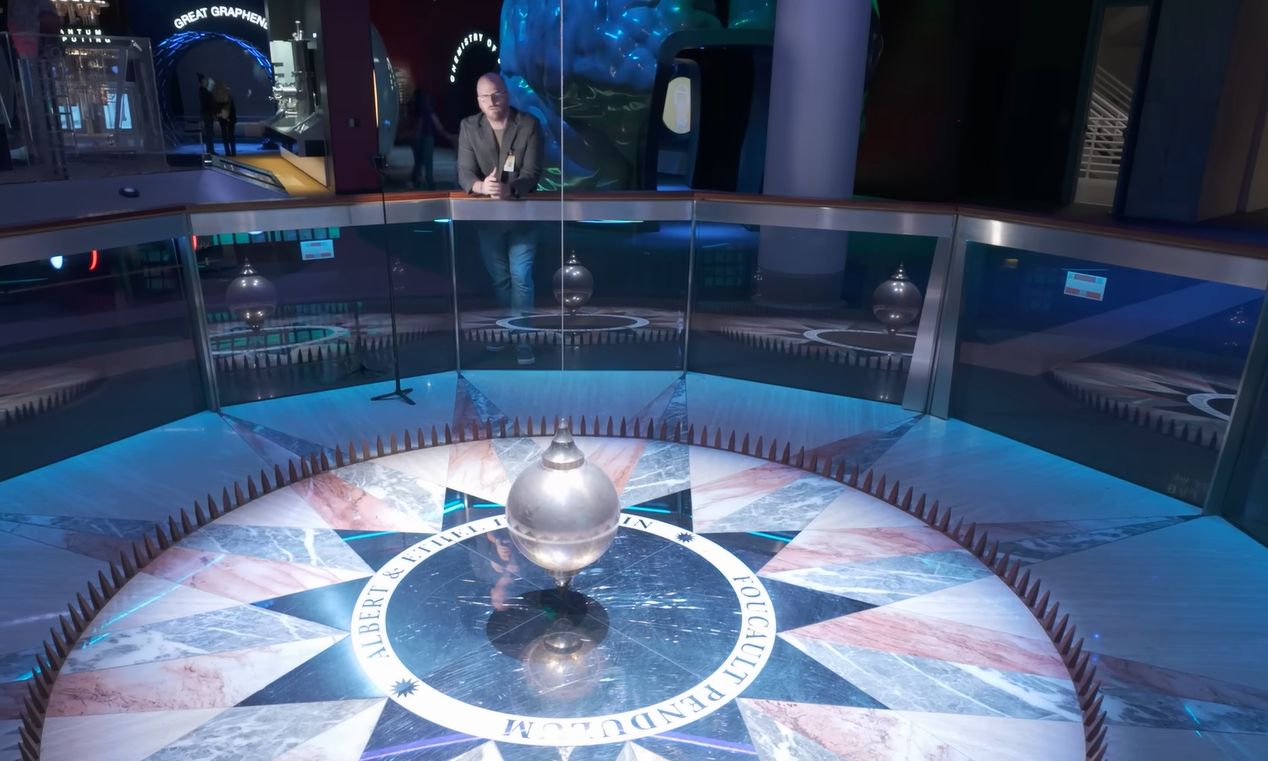
The Houston Museum of Natural Science has reported a significant malfunction: their Foucault pendulum has ceased swinging for the first time since its installation in the 1970s. The pendulum, which serves as an engaging demonstration of Earth’s rotation, requires repairs to its electromagnetic system, which is responsible for maintaining its motion.
Understanding the Foucault Pendulum’s Mechanism
This particular pendulum, known as the Herzstein Foucault pendulum, weighs 81.6 kg and completes a full rotation approximately every 48 hours. As the pendulum swings, it tips over pins placed along its circumference, showcasing the precession caused by Earth’s rotation. Museum officials have released an explainer video detailing both the physics behind this phenomenon and the construction of the pendulum itself.
Invented by Léon Foucault in 1851, the Foucault pendulum is a practical demonstration of Earth’s movement. It appears to maintain a constant swing, yet the plane of oscillation gradually shifts, creating the illusion of rotation around its pivot point. This effect varies depending on the pendulum’s geographic location. For instance, at the poles, the pendulum precesses in exactly 24 hours, while at the equator, it remains stationary.
The significance of the Foucault pendulum extends beyond mere visual interest; it serves as a testament to scientific principles that continue to captivate audiences in museums worldwide. Its ability to illustrate Earth’s rotation is particularly valuable in educational settings, where it challenges misconceptions about the planet’s shape and movement.
Future Steps for the Houston Museum
The museum is currently assessing the situation to ensure that the pendulum can be restored to its full functionality. Officials expressed optimism regarding the repair process and the hope that visitors will soon be able to witness the pendulum in action once again. A thorough examination of the pendulum’s internal mechanisms is planned, and the museum has indicated that a video showcasing this repair process might be produced.
As the museum embarks on this repair journey, the Foucault pendulum remains a powerful symbol of scientific inquiry and exploration, inviting questions about the natural world and our understanding of it. The museum’s commitment to restoring the pendulum highlights the importance of maintaining educational tools that inspire curiosity and learning.