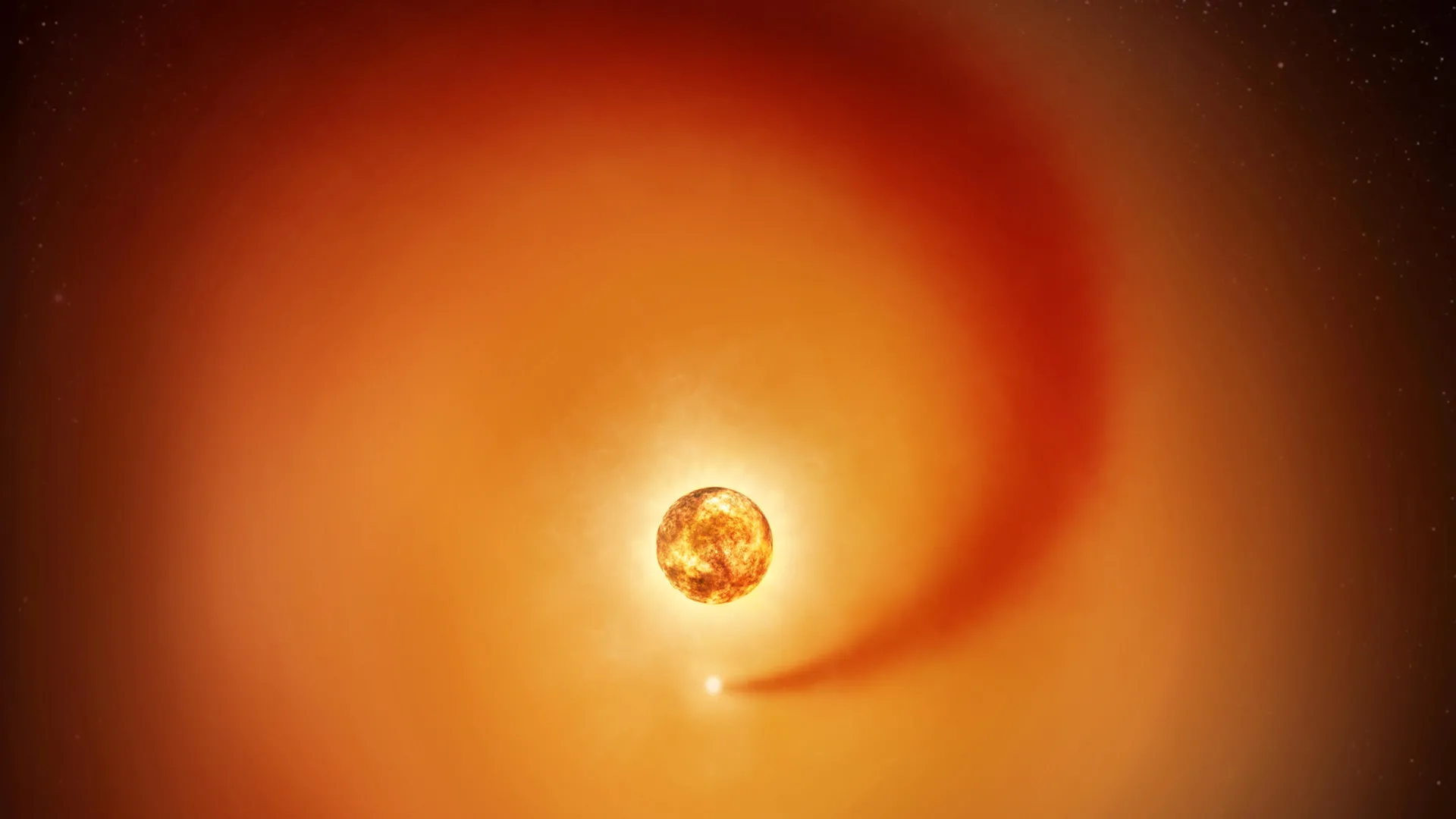
NASA astronomers have identified a hidden companion star to Betelgeuse, revealing the cause behind the giant star’s peculiar behavior. This discovery, made using nearly eight years of observations from the Hubble Space Telescope and ground-based observatories, shows that the companion star, named Siwarha, is creating a visible wake in Betelgeuse’s vast atmosphere.
The research, led by the Center for Astrophysics | Harvard & Smithsonian (CfA), was presented at the 247th meeting of the American Astronomical Society in Phoenix and is set to be published in The Astrophysical Journal. The findings enhance our understanding of Betelgeuse, which is located approximately 650 light-years from Earth in the constellation Orion.
Unraveling the Mystery of Betelgeuse
Astronomers have long monitored Betelgeuse for its unpredictable brightness variations. By meticulously analyzing changes in the star’s light over almost a decade, scientists have confirmed the presence of the companion star, which was suspected but not previously validated. As Siwarha traverses Betelgeuse’s outer layers, it disrupts the surrounding gas, forming a trail of denser material.
This wake, observed shortly after the companion passes in front of Betelgeuse approximately every 2,100 days, explains the longstanding questions surrounding the star’s variability. Astronomer Andrea Dupree, the lead author of the study, stated, “It’s a bit like a boat moving through water. The companion star creates a ripple effect in Betelgeuse’s atmosphere that we can actually see in the data.”
Implications for Stellar Evolution
Betelgeuse, a red supergiant, is significant due to its immense size and proximity to Earth, allowing for detailed study of its surface and atmosphere. The discovery of Siwarha not only resolves one of the enduring puzzles of Betelgeuse but also provides insights into the late evolutionary stages of massive stars.
Before this revelation, various theories were proposed to explain Betelgeuse’s brightness fluctuations, including massive convection cells, dust clouds, and magnetic activity. However, the identification of Siwarha as a low-mass star orbiting within Betelgeuse’s atmosphere offers the clearest evidence yet of a companion impacting the star’s behavior.
Dupree emphasized the importance of this finding, saying, “Finding the wake from its companion means we can now understand how stars like this evolve, shed material, and eventually explode as supernovae.”
Astronomers are planning additional observations in 2027 when Siwarha becomes visible again, which may aid in further unraveling the complexities of other giant stars in the universe. The Hubble Space Telescope continues to be a vital asset in the pursuit of astronomical knowledge, with over 30 years of contributions to the field.
The collaboration between NASA and the European Space Agency (ESA) ensures the ongoing success of the Hubble mission, which remains a cornerstone of modern astronomy. The discoveries made possible through Hubble’s observations deepen our understanding of stellar phenomena and the life cycles of stars, greatly enhancing our cosmic perspective.