
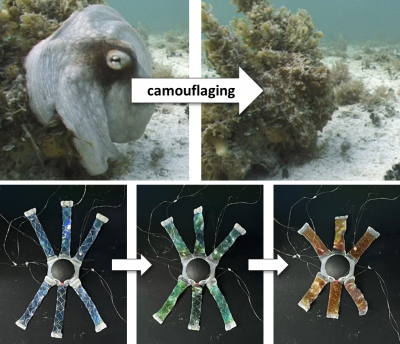
Researchers at the Korea Institute of Science and Technology (KIST) have unveiled a groundbreaking soft robot named OCTOID. Led by Dr. Dae-Yoon Kim, this innovative creation mimics the camouflage abilities and fluid movement of octopuses, marking a significant advancement in robotics.
The OCTOID distinguishes itself from traditional soft robots by not only bending and stretching but also by changing color in response to electrical stimulation. This ability allows it to adapt its appearance to blend seamlessly with its surroundings, much like its biological counterpart. The robot’s integrated design enables it to move dynamically, enhancing its capacity to grasp and manipulate objects.
Innovative Features and Applications
The development of OCTOID showcases a leap forward in soft robotics, which often struggles with the limitations of rigidity and functionality. By incorporating advanced materials and mechanisms, the research team at KIST has created a robot that can perform complex tasks while maintaining flexibility.
The potential applications for OCTOID are vast. Its ability to change color and shape could revolutionize fields such as search and rescue operations, where blending into an environment can provide critical advantages. Additionally, in medical settings, such robots could assist in delicate procedures by adapting their form to navigate complex anatomical structures.
Dr. Kim emphasized the importance of this technology, stating, “Our goal was to create a robot that not only performs tasks but does so in a way that is intuitive and adaptable to its environment.” This vision aligns with broader trends in robotics, where the focus is shifting towards creating machines that can interact more naturally with the world around them.
A Collaborative Effort at KIST
The research project was conducted at the Functional Composite Materials Research Center of KIST, under the leadership of Sangrok Oh, the center’s president. The team’s collaborative approach brought together expertise from multiple disciplines, including materials science, robotics, and biomimicry.
In a field where advancements can often be slow, the rapid development of OCTOID is a testament to the innovative spirit at KIST. This project not only highlights the potential of soft robotics but also sets a precedent for future research endeavors that seek to harness the complexities of nature in technological applications.
As the world continues to evolve technologically, the introduction of robots like OCTOID may redefine our understanding of robotics and its capabilities. With ongoing research and development, KIST is poised to remain at the forefront of this exciting field, paving the way for the next generation of intelligent machines.


