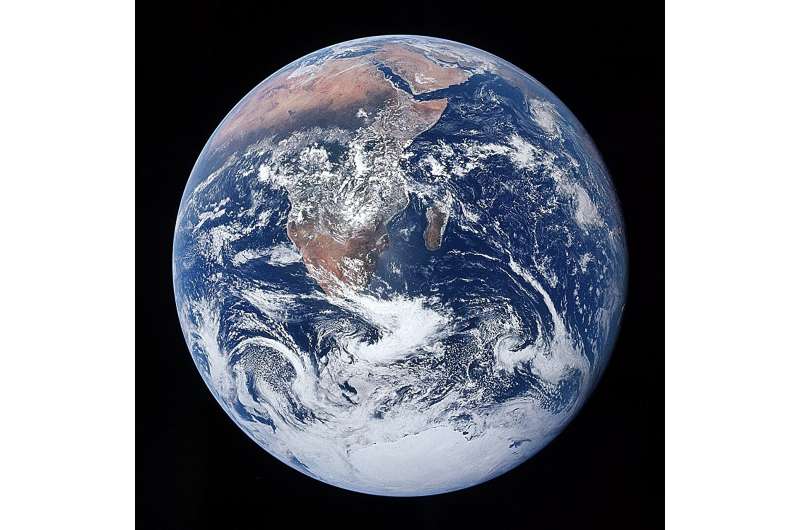
Research led by Stephen Kane has unveiled that Mars plays a significant role in influencing Earth’s climate patterns. The findings, shared on December 10, 2025, highlight how variations in Mars’s mass can affect the complex climate cycles that have governed Earth for millions of years.
Earth’s climate has fluctuated between ice ages and warmer periods due to subtle changes in its orbit and axial tilt, known as Milankovitch cycles. These cycles are driven not only by Earth’s relationship with the Sun but also by the gravitational pull of nearby planets. While Jupiter and Venus have long been recognized as major players, this new analysis indicates that Mars exerts a surprisingly strong influence as well.
Research Findings and Implications
Kane and his team conducted computer simulations, varying Mars’s mass from zero to ten times its current value. The results demonstrated that while the 405,000-year eccentricity cycle, primarily influenced by Venus and Jupiter, remains stable regardless of Mars’s mass, the shorter cycles—approximately 100,000 years—are critically dependent on Mars. As Mars’s mass increased in the simulations, these shorter cycles became longer and more pronounced, indicating enhanced interactions among the inner planets.
Perhaps most notably, when Mars’s mass approached zero in the models, a vital climate pattern vanished entirely. The 2.4 million-year “grand cycle,” which contributes to long-term climate fluctuations on Earth, exists due to Mars’s gravitational influence. This cycle is tied to the slow rotation of Earth’s and Mars’s orbits, affecting the amount of sunlight Earth receives over extensive periods.
Furthermore, Mars’s gravitational pull impacts Earth’s axial tilt, or obliquity. The 41,000-year obliquity cycle, documented in geological records, lengthens as Mars becomes more massive. With Mars ten times heavier than its current mass, the cycle shifts to a period of 45,000 to 55,000 years, significantly altering patterns of ice sheet growth and retreat.
Broader Implications for Exoplanets
This research has implications that extend beyond Earth. Understanding how Mars influences climate cycles can aid in assessing the habitability of Earth-like exoplanets. A terrestrial planet with a massive neighboring planet in the correct orbital configuration may experience climate variations conducive to life, potentially preventing extreme conditions such as runaway freezing.
The study underscores that Earth’s Milankovitch cycles are not solely a product of its relationship with the Sun. Rather, they are influenced by the entire planetary neighborhood, with Mars playing an unexpectedly pivotal role in shaping Earth’s climate.
For more detailed insights, the full research is available in the preprint repository, arXiv, under the title “The Dependence of Earth Milankovitch Cycles on Martian Mass.” This groundbreaking work opens new avenues for exploring how planetary dynamics can influence climate across the universe.