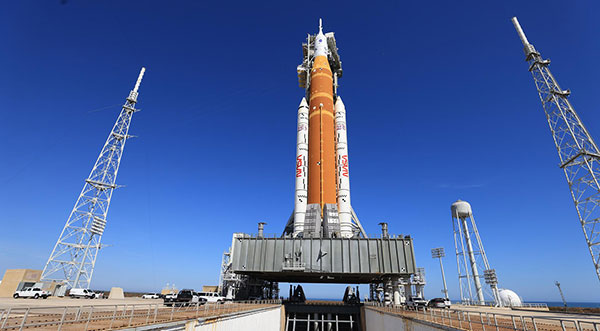
NASA has initiated preparations to potentially roll back the Artemis II rocket and the Orion spacecraft to the Vehicle Assembly Building (VAB) at Kennedy Space Center in Florida. This decision follows an incident on February 21, 2024, when the agency observed an interrupted flow of helium to the Space Launch System (SLS) rocket’s interim cryogenic propulsion stage.
Engineers are actively reviewing data to diagnose the problem while making necessary adjustments to facilitate a rollback if needed. The interrupted helium flow impacts the environmental conditions essential for the upper stage’s engine and the pressurization of its liquid hydrogen and liquid oxygen propellant tanks.
Technical Review and Preparedness
Teams at NASA are examining various potential causes of the helium flow issue. This includes investigating the interface between ground and rocket lines designed to route helium, as well as a valve within the upper stage and a filter located between the ground and the rocket. The systems functioned correctly during the Artemis II wet dress rehearsals, yet proper helium flow could not be achieved during subsequent normal operations following the rehearsal that concluded on February 19, 2024.
Operators are currently employing a backup method to sustain the environmental conditions for both the upper stage engines and the rocket, which remains in a safe configuration. Preparations are also underway to remove access platforms at Pad B to ensure troubleshooting options are available at both the launch pad and the VAB. Due to forecasted high winds, these platforms, installed just the previous day, must be removed promptly, as they cannot be dismantled under such conditions.
Launch Window Implications
The rollback would mean that NASA will not launch Artemis II during the upcoming March launch window. However, by swiftly addressing these issues, the agency aims to preserve the possibility of launching in April, depending on the outcome of ongoing data analysis and repair efforts, as well as how the schedule unfolds in the coming days.
This development is a significant aspect of NASA’s broader Artemis program, which aims to return humans to the Moon and eventually facilitate missions to Mars. As the team continues its preparations and troubleshooting, the agency remains focused on ensuring that Artemis II will achieve its critical objectives.