On January 10, 2024, a significant chapter in space exploration concluded as NASA demolished two historic test stands at the Marshall Space Flight Center in Huntsville, Alabama. The structures, known as the Dynamic Test Stand and the Propulsion and Structural Test Facility—commonly referred to as the T-tower—were critical to the development of rocket technology that propelled humans to the moon. Their carefully orchestrated implosions symbolized both a farewell to an era of achievement and a step towards modernization.
The Legacy of the T-tower and Dynamic Test Stand
Constructed in the late 1950s and early 1960s, these test stands were pivotal in the early days of the space age. The T-tower, established in 1957 by the Army Ballistic Missile Agency before NASA’s inception, stood at over 50 meters and was utilized for static testing. This process involved firing rockets at full power while securely restrained, allowing engineers to monitor critical parameters such as vibrations and pressure fluctuations. Under the guidance of renowned rocket scientist Wernher von Braun, the T-tower tested components of the Saturn family of launch vehicles, which included the powerful F-1 engines that would eventually be instrumental in the Apollo missions. Its last significant role came in the 1990s when it was used to test Space Shuttle solid rocket boosters.
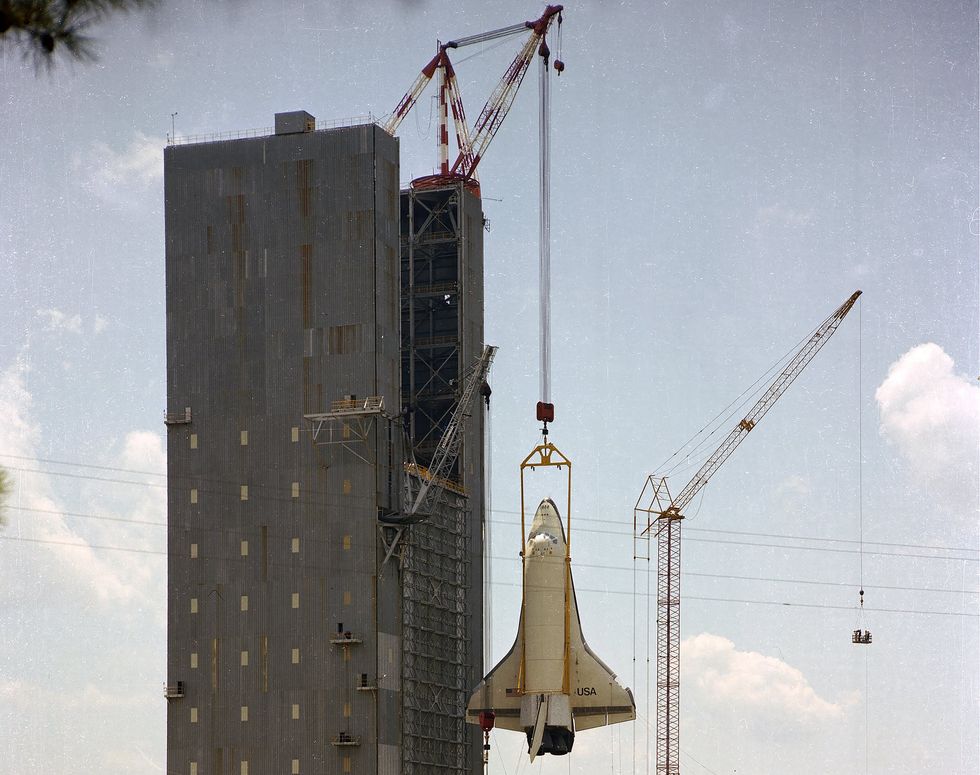
In contrast, the Dynamic Test Stand, built in 1964 and rising more than 105 meters tall, became the tallest human-made structure in North Alabama. This facility played a vital role in simulating the mechanical stresses and vibrations that fully assembled Saturn V rockets would encounter during actual flight. Ensuring that every aspect of the rocket could withstand these conditions was crucial, as any failure during a launch could have catastrophic consequences. The stand continued to play an essential role in the space program, including the integration of all elements of the Space Shuttle in 1978. Its final function came in the early 2000s, when it was repurposed as a drop tower for microgravity experiments.
Acknowledging History While Embracing the Future
Both the T-tower and the Dynamic Test Stand were designated as National Historic Landmarks in 1985, recognizing their invaluable contributions to human spaceflight. The decision to demolish them, while bittersweet, was deemed necessary due to safety concerns and the need to allocate resources more effectively for current missions. NASA is in the process of removing 19 outdated structures as part of a broader initiative to transform the Marshall campus into a modern, interconnected facility that supports future endeavors in space exploration.
Acting director of the Marshall Space Flight Center, Rae Ann Meyer, expressed the mixed emotions surrounding the demolition. “These facilities helped NASA make history. While it is hard to let them go, they’ve earned their retirement. The people who built and managed these facilities and empowered our mission of space exploration are the most important part of their legacy,” she stated.
To preserve this legacy, NASA has taken steps to document the history of these structures. Detailed architectural drawings, photographs, and written histories are now housed in the Library of Congress. Additionally, Auburn University has created high-resolution digital models using LiDAR and 360-degree photography, capturing the test stands in intricate detail before their destruction. These virtual archives will allow future generations to appreciate the monumental engineering achievements represented by these towers, even after they have been dismantled.
As NASA looks forward to new challenges in space exploration, the memories of the T-tower and the Dynamic Test Stand will endure, reminding us of the incredible journey that has brought humanity closer to the stars.