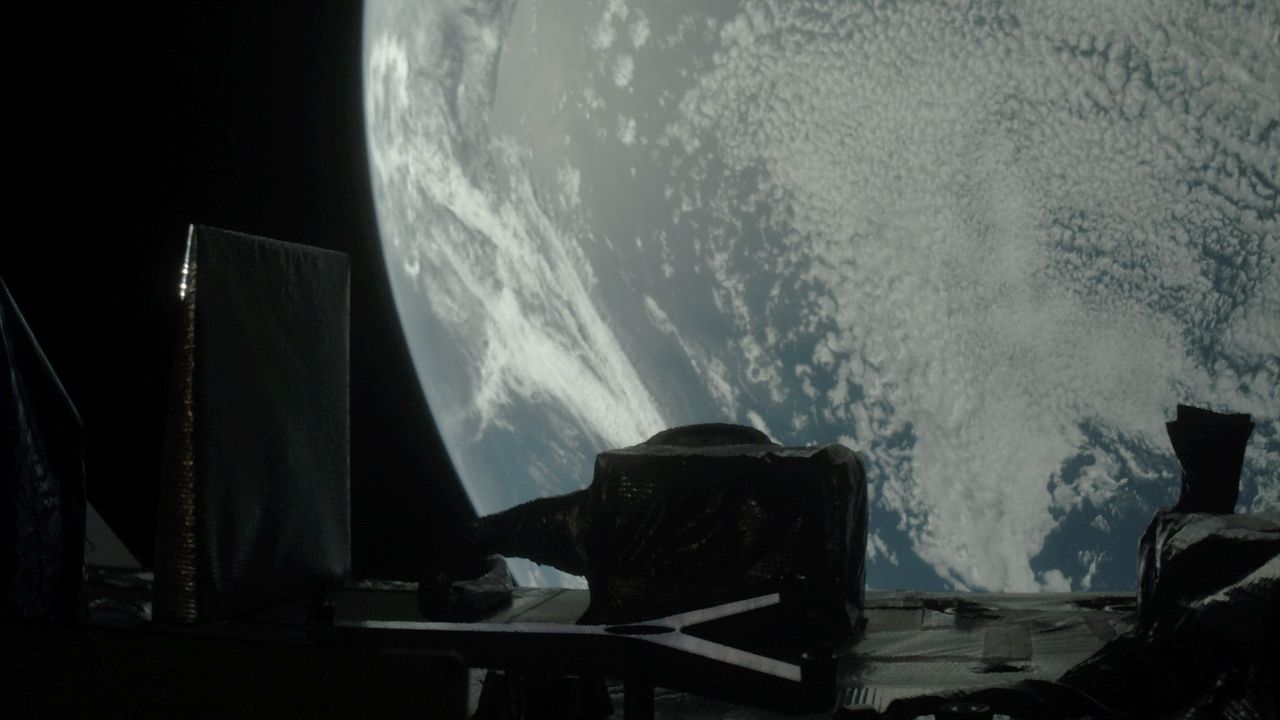
NASA’s OSIRIS-APEX spacecraft has successfully captured remarkable images of Earth and the Moon during its recent flyby, marking a significant milestone in its mission to explore the asteroid Apophis. On September 23, 2025, the spacecraft executed a high-speed slingshot maneuver, passing just 2,136 miles (approximately 3,438 kilometers) above Earth’s surface. This maneuver not only provided stunning imagery but also set the course for its journey toward Apophis.
The images reveal swirling clouds over the planet’s blue oceans and glimpses of continents below. As OSIRIS-APEX departed from Earth, it also took a striking photograph of the Moon from about 370,000 miles (close to 595,000 kilometers) away, illustrating the impressive capabilities of its imaging instruments.
Mission Background and Objectives
OSIRIS-APEX, which stands for “Origins, Spectral Interpretation, Resource Identification and Security-Apophis Explorer,” is the second phase of the OSIRIS-REx mission. This earlier mission successfully returned samples from the near-Earth asteroid Bennu in 2023. Following this historic achievement, NASA redirected its focus toward Apophis, a stony, metal-rich asteroid that presents a sharp scientific contrast to Bennu’s carbon-rich nature. Notably, Apophis was once considered a potential threat to Earth, making this mission particularly significant.
The recent flyby confirmed that OSIRIS-APEX’s cameras and instruments are fully operational after years of traveling through deep space. The primary purpose of this maneuver was to utilize Earth’s gravity to boost the spacecraft’s speed and redirect it toward Apophis, which is expected to make a close approach to Earth on April 13, 2029. During this encounter, Apophis will come closer than many satellites orbiting our planet, allowing researchers to study the effects of Earth’s gravitational forces on the asteroid, including potential changes to its surface and orbit.
Future Endeavors and Scientific Exploration
Once OSIRIS-APEX reaches Apophis, it will enter orbit and spend approximately 18 months mapping the asteroid, analyzing its composition, and capturing high-resolution images. Mission planners have ambitious goals, including hovering just above the asteroid’s surface and using the probe’s thrusters to dislodge dust, revealing previously hidden materials.
The spacecraft’s images of Earth were taken with its MapCam imager, which employs red, green, and blue filters. The StowCam, capable of both still and video imagery, ensures the safe storage of asteroid samples collected during the mission. As OSIRIS-APEX continues its journey, it will provide trajectory updates and perform additional instrument checks, paving the way for unprecedented close-up views of Apophis.
This mission not only aims to enhance our understanding of asteroids but also seeks to unravel the complexities of how these celestial bodies evolve over time and respond to gravitational influences. As scientists prepare for the upcoming close encounter with Apophis, the insights gained from OSIRIS-APEX will be crucial for future planetary defense strategies and our broader understanding of the solar system.