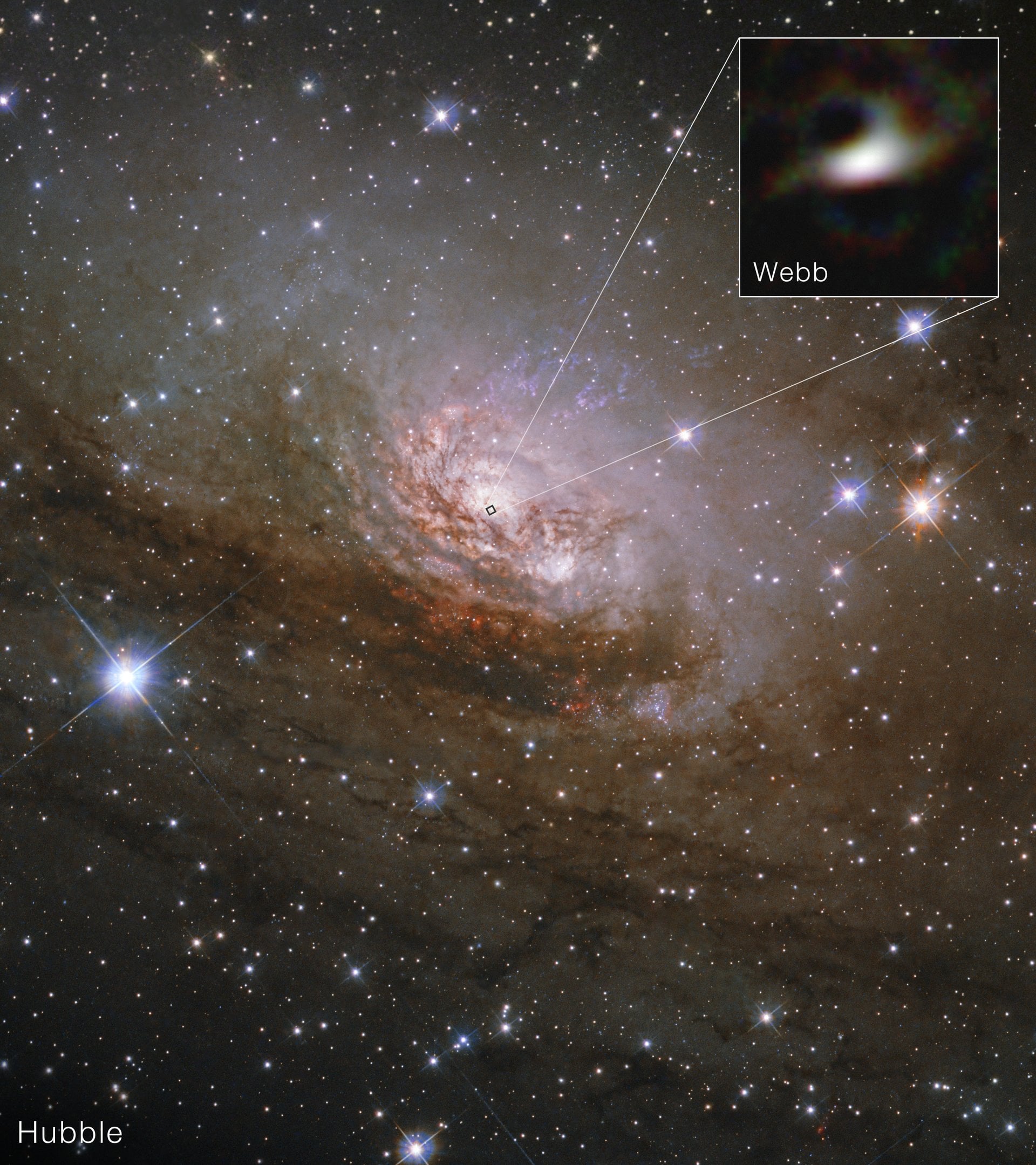
NASA’s James Webb Space Telescope (JWST) has provided groundbreaking insights into the Circinus Galaxy, located approximately 13 million light-years from Earth. Recent observations have allowed scientists to peer into the core of this galaxy, revealing unexpected details about the behavior of its supermassive black hole (SMBH) and challenging previously held theories regarding the origins of its infrared emissions.
Historically, astronomers believed that the core of Circinus primarily emitted infrared light due to outflows of superheated material. However, the latest data from JWST indicates that a significant portion of this emission is actually the result of material being consumed by the black hole itself. This finding marks a pivotal shift in understanding how these cosmic giants interact with their surroundings, particularly in the context of Active Galactic Nuclei (AGNs).
New Observations Challenge Existing Models
The research team, led by Enrique Lopez-Rodriguez of the University of South Carolina, employed the Aperture Masking Interferometer on the JWST’s Near-Infrared Imager and Slitless Spectrograph (NIRISS) to filter out the bright starlight that often obscures observations. By utilizing a unique aperture design featuring seven hexagonal holes, the team could combine light from multiple sources, creating interference patterns that enhance the clarity of distant objects.
Lopez-Rodriguez explained, “Previous models found that most of the infrared emission from the center of Circinus could be traced to outflows. To test this theory, astronomers needed instruments that could filter out the obscuring starlight and distinguish the torus’s infrared emission from that of the outflows.”
The data collected led to the construction of a detailed image of the central region of Circinus, which the researchers compared against prior observations to confirm the absence of artifacts. This represents the first extragalactic observation performed by a space-based infrared interferometer, yielding the sharpest image of a black hole’s surroundings to date.
Key Findings and Implications for Future Research
The implications of this research are profound. Co-author Joel Sanchez-Bermudez from the National University of Mexico noted that the team’s findings revealed that only less than 1% of the infrared emission comes from hot dusty outflows. In contrast, a staggering 87% of the infrared light is generated by regions closest to the black hole, with the remaining 12% arising from hot dust located further away.
This innovative technique also holds promise for analyzing other black holes. Lopez-Rodriguez remarked, “We hope our work inspires other astronomers to use the Aperture Masking Interferometer mode to study faint, but relatively small, dusty structures in the vicinity of any bright object.” By examining additional black holes, researchers could compile a catalog of emission data to determine whether Circinus is an anomaly or part of a broader trend.
The findings of this study were published on January 13, 2023, in the journal Nature Communications. As scientists continue to unlock the secrets of SMBHs, the data gathered from JWST will play a crucial role in advancing our understanding of galaxy evolution and the intricate dance between black holes and their environments.