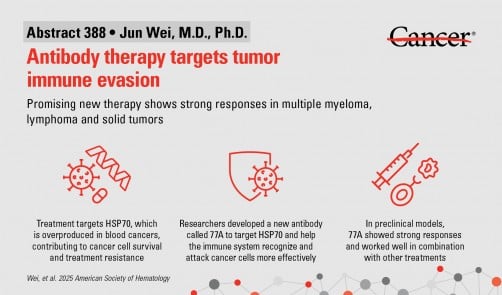
Researchers from The University of Texas MD Anderson Cancer Center have developed a new investigational therapy, known as 77A, which enhances the immune response against various cancers, including blood cancers and solid tumors. This breakthrough was presented on December 6, 2025, at the 67th American Society of Hematology (ASH) Annual Meeting in Orlando. The therapy targets the heat shock protein HSP70, helping to overcome treatment resistance seen in conditions such as myeloma and lymphoma.
The study, led by Jun Wei, M.D., Ph.D., an assistant professor of Lymphoma & Myeloma, and Robert Z. Orlowski, M.D., Ph.D., a professor in the same department, highlights the potential of 77A to reshape the tumor environment and activate immune cells. According to Wei, “There is tremendous promise in the way 77A is capable of rewiring the immune system, enabling it to respond effectively against multiple cancers.” This marks a significant step forward in immunotherapy research.
Mechanism of Action and Laboratory Results
The 77A antibody functions by targeting HSP70, a protein that often allows tumors to evade the immune system. Elevated levels of HSP70 are frequently found in blood cancers and solid tumors, creating a challenging environment for immune responses. In laboratory models, 77A demonstrated robust antitumor effects by boosting the activity of both innate and adaptive immune cells, such as natural killer (NK) cells and T cells.
The therapy has shown promise in enhancing the efficacy of existing treatments, including chemotherapy, radiation therapy, and immune checkpoint blockade. It may also be effective when combined with adoptive T cell therapy, an innovative approach where patients receive engineered immune cells designed to attack cancer.
Next Steps and Clinical Implications
The results from this study indicate that 77A not only displays strong activity against multiple cancer types in laboratory settings but also enhances immune responses in early tests involving human immune cells. These findings open the door for potential clinical trials, suggesting that 77A could emerge as a versatile therapeutic option for cancer patients.
Robert Z. Orlowski expressed confidence in the antibody’s potential, stating, “These results give us confidence that 77A could become a versatile immunotherapy.” The next phase of research will focus on developing a humanized version of the antibody, which is expected to enter clinical trials soon.
The study received support from Blood Cancer United, previously known as the Leukemia & Lymphoma Society. A full list of collaborating authors and their disclosures can be found with the abstract from the ASH meeting. The ongoing development of 77A promises to contribute significantly to the evolving landscape of cancer treatment.