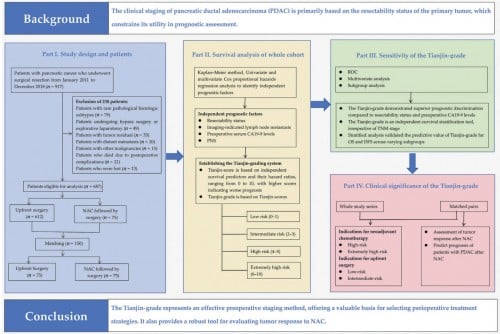
Pancreatic ductal adenocarcinoma (PDAC) poses significant challenges in treatment and prognosis due to its aggressive nature and limited predictive tools. Traditional staging systems, such as the TNM classification, primarily focus on anatomical factors, often failing to provide a comprehensive prognosis. In response to this limitation, researchers at Tianjin Medical University Cancer Institute & Hospital developed the Tianjin Grading System, which integrates anatomical, biological, and patient-specific factors to enhance risk stratification and ultimately improve patient outcomes.
The Tianjin Grading System was published in Cancer Biology & Medicine in 2025, following a comprehensive retrospective analysis of 687 PDAC patients who underwent surgical resection. Researchers identified key prognostic indicators, including lymph node metastasis, serum CA19-9 levels, and nutritional status, to formulate a more holistic grading approach. This new system categorizes patients into four distinct risk groups: low-risk (0-1), intermediate-risk (2-3), high-risk (4-5), and extremely high-risk (6-10). Each group demonstrated significantly different survival outcomes.
The study highlighted that patients classified as high-risk and extremely high-risk realized considerable benefits from neoadjuvant chemotherapy (NAC). Importantly, the Tianjin Grading System outperformed traditional methods, such as serum CA19-9 alone and anatomical resectability, in predicting overall survival (OS) and disease-free survival (DFS). This multi-dimensional approach emphasizes the necessity of integrating various factors in assessing PDAC to better guide treatment strategies.
Key Findings and Implications
Dr. Jihui Hao, a lead researcher on the project, remarked on the significance of the Tianjin Grading System, stating, “This system helps us better understand which patients will benefit most from aggressive treatments like neoadjuvant chemotherapy, paving the way for more personalized, effective care strategies.” The ability to predict outcomes more accurately allows healthcare providers to tailor treatment plans, ensuring that high-risk patients receive appropriate interventions while avoiding overtreatment of low-risk individuals.
The implications of this grading system extend beyond individual patient care. By providing a comprehensive assessment that uses standard imaging and laboratory tests, the Tianjin Grading System offers a practical tool for diverse clinical settings, including those with limited resources. Its accessibility establishes a new standard in personalized pancreatic cancer care and improves clinical decision-making.
The study emphasizes the importance of further research into integrating biological markers into preoperative assessments for PDAC. This approach could lead to enhanced prognostic capabilities and support better treatment outcomes for patients facing this challenging diagnosis.
The development of the Tianjin Grading System was supported by the Tianjin Natural Science Foundation (Grant No. 24JCYBJC00580). The findings underscore the critical need for ongoing innovation in the management of pancreatic cancer, a disease that continues to present significant challenges for patients and healthcare providers alike.